
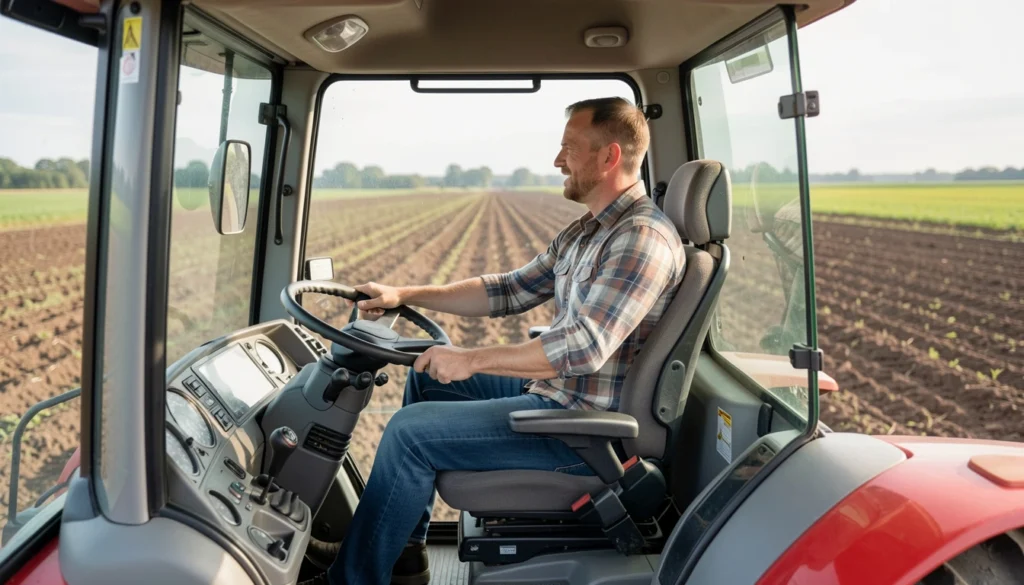
It’s not the PTO shaft. It’s not the hydraulic lines. It’s the seat.
That’s not a contrarian take; it’s a measure of how long the industry treated operator seating as a trim option and not a safety system. Every hour a farmer spends on a machine with a worn, poorly adjusted, or inadequately suspended seat is an hour of cumulative physical stress that degrades both their body and their ability to operate safely.
Fatigue Isn’t Just Tiredness
There is a general assumption that operator fatigue is synonymous with sleepiness. The physical reality is more precise than that. As muscular fatigue accumulates over a long shift, peripheral vision diminishes, reaction time decelerates, and spatial awareness declines. These are not vague well-being issues; they are the physiological conditions that exist immediately before most equipment-related events.
A seat that immobilizes the operator in an unsupported posture compresses that schedule. When the lower back is continually activating to maintain stance over rough ground as opposed to being supported by it, the cognitive load goes up regardless of how nothing else appears to be occurring. The operator is spending mental energy on physical discomfort, which leaves less available for what’s actually happening around the machine.
Modern GPS auto-steer and assisted steering systems don’t resolve this issue. They reduce the physical work of steering, but they still require active human supervision. If the operator is too uncomfortable to stay focused, the technology doesn’t compensate for it.
The Vibration Problem Compounds Silently
Whole-body vibration (WBV) is actually far and away the greatest source of physical stress and long-term damage to farm machinery operators. But it’s also invisible till things go really wrong.
The low-frequency oscillations that WBV insidiously transmits through the seat during hours of machine use create micro-trauma to the discs between the vertebrae. That kind of injury becomes cumulative over months and years before manifesting as a specific, discernible injury. By the time a farmer becomes a back patient, the costly-to-treat degradation has often been underway for years.
In numerous ag vehicles, WBV measurements are over the action levels prescribed by international safety standards for an 8-hour workday (NIOSH). The ISO standard (2631-1), which outlines how human exposure to Whole Body Vibration should be measured and evaluated, also outlines how to determine if exposure could cause discomfort, pain, or harm. Most farm operations have never had any means to know if their machines go over those thresholds.
Air suspension seating pretty straightforwardly addresses that. A pneumatic bellows system actively absorbs and mitigates vertical shocks instead of dumping them straight through your lower spine. The mechanical suspension (“spring-and-shock”) designs present in older or entry-level seats might be fine for lighter conditions, but under heavy-duty use over rough ground, they offer next to no protection for a working man or woman’s long-term health.
Torsion Strain and Secondary Controls
Another overlooked health issue for farmers is torsion strain, especially among operators using rear-mounted implements. They spend a lot of time rotating their torso to look back and see what the implement is doing. Over time, that motion can put stress on the spine. Without a swivel base, the operator sits too far to the right, or without proper armrest support, the operator will twist the seat pan to find an armrest to lean on.
Generally, torsion strain is easier to overlook than back pain. Symptoms show up a year or two later. They might be sporadic at first. Lumbar and thoracic strains may not be severe enough to stop an operator from working. However, over time, they can take their toll, making an operator slower and less accurate in performing fine motor functions like operating a control.
The Cost Calculation Most Operators Get Wrong
Delaying seat upgrades is common in agriculture. There are hundreds of tasks to do between seasons, and up-time is precious, and there’s never a line item for “Operator Well-being and Sitting Comfort” in any budget.
Seating upgrades get delayed because they feel optional. The machine still runs, so the seat gets treated as a cosmetic issue. The actual cost comparison looks different once you account for what a workplace injury costs, time off, farm downtime, workers’ compensation claims, and years of healthcare expenses for a chronic condition.
A high-quality seat replacement, including models with air suspension and adjustable lumbar support, is a fraction of those costs. For older tractors where the original seat has degraded, fitting a universal tractor seat is often the most cost-effective way to bring the machine’s operator safety profile back up to standard without a full cab refit.
Reframe What a Safety Upgrade Means
Protective equipment such as roll-over protection, lighting, and backup alarms are topics that have been part of the farm safety discussion for some time. Seating falls into that category as well. It is quite literally the one component of the machine the operator is in contact with for every minute of its operation. Its condition has a direct influence on the operator’s physical health, cognitive state, and ability to operate the machine.
Treating it as an afterthought is a risky decision, even if it doesn’t feel like one.
