
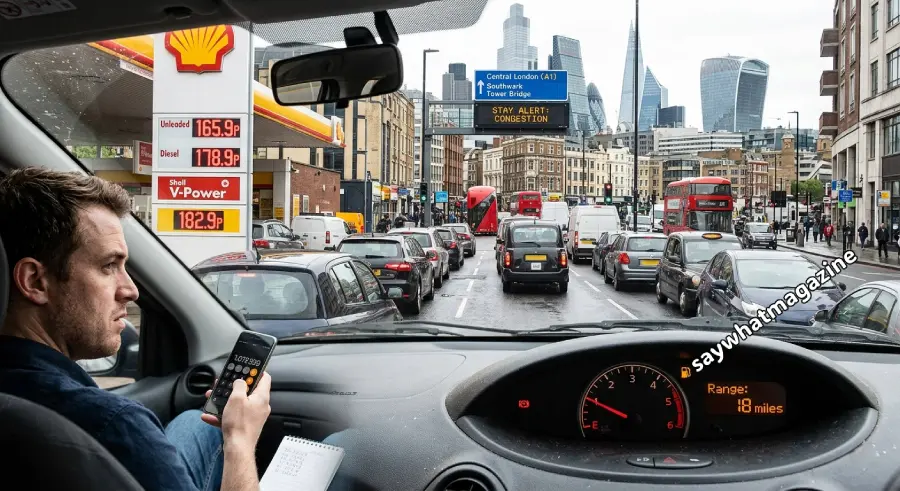
Driving across London is painfully expensive right now. With petrol hovering around 158p a litre the simplest way to cut your fuel consumption by up to 25 percent is to combine eight basic habits. You need to check your tyre pressures regularly, drive smoother in traffic, drop your motorway speeds to 70mph on the M25, turn off cruise control on hills, remove heavy junk and roof racks, plan routes to avoid congestion, service your engine, and stop idling at red lights. Doing these things actually works.
Keep your tyres pumped up
Most of us just kick the tyres and assume they are fine. I think it is probably the most ignored part of car ownership. But under-inflated tyres increase road friction MASSIVELY. Your engine has to work harder just to push the car forward against the tarmac.
RAC experts reckon that a drop of just 1 bar in pressure can increase your fuel consumption by up to 10 percent. That adds up to roughly £20 or £30 extra per tank depending on what you drive. It is literally burning money because of laziness.
I used to ignore the little yellow warning light on my dash for weeks. I assumed it was just a faulty sensor playing up again. Then I actually checked the pressure at a local garage on the South Circular and realised I was driving on incredibly soft rubber. Taking five minutes to inflate them makes a noticeable difference. The car rolls easier & you use less petrol.
It also prevents uneven wear on your tyres so you don’t have to replace them as often.
Stop racing to the next red light
We all know the feeling of being stuck behind a slow bus on the Old Kent Road. The temptation to floor it the second you get an overtaking lane is incredibly strong. Hard acceleration and heavy braking wastes a massive amount of petrol.
Smooth driving alone can deliver 25 percent better mileage in urban traffic. The constant stop-start rhythm of the city is terrible for efficiency. You speed up just to slam on the brakes twenty yards later. It makes no sense.
Then there is the idling problem. Sitting in standstill traffic with the engine running wastes between half a litre to a full litre of fuel every hour. Transport for London actually warns that idling is illegal if you sit for more than 60 seconds. Turn the engine off.
Sometimes you have to accomodate other drivers and just go with the slow flow. Limit your air conditioning too unless it is absolutely boiling outside. It adds another 10 to 20 percent to your fuel usage when you are crawling along at 5mph. Open a window instead if you are stuck in a queue.
Slow down a bit on the M25
Getting out of the city usually means hitting the M25 or the A406. Everyone wants to do 80mph to make up for lost time sitting in traffic earlier.
Aerodynamic drag rises exponentially once you go over 70mph. Dropping your speed back down to the legal limit improves your fuel economy by 10 to 15 percent. Professor David Cebon from Cambridge University did a whole study on this. You hardly lose any time on the journey but you keep a lot more petrol in the tank. It is a very simple trade.
Cruise control is brilliant for flat stretches of the motorway. It keeps your speed steady & stops you creeping up into fuel-guzzling speeds.
But you should turn it off when you hit hills. The system will aggressively rev the engine to maintain the exact speed up a gradient. Letting your speed drop slightly on the uphill sections prevents that extra engine strain. You can always pick the speed back up on the way down.
Clear out the junk in your boot
Cars end up becoming mobile storage lockers. Buggies, old gym bags, random boxes you meant to take to the tip weeks ago. Every extra kilogram demands more fuel to move it.
An excess weight of 50kg boosts fuel use by around 2 percent. That might not sound like much but it accumulates over a year. Roof racks are the real killers though.
An empty roof rack creates wind drag that can cause a 25 percent fuel penalty. Why leave it on if you are not carrying bikes or a top box? Take it off. Store it in the shed.
The Energy Saving Trust constantly reminds drivers about this. People leave roof boxes on their SUVs all year round because they cannot be bothered to unbolt them. That laziness is costing a fortune at the pumps.
Plan your routes around the traffic
Sitting in heavy congestion is the fastest way to empty your wallet. Add the daily ULEZ charges of £12.50 and the £15 Congestion Charge, and driving becomes an absolute luxury.
Combine your local errands into one trip. Doing three separate runs to the shops means three cold starts. Engines use up to 15 percent more fuel when they are cold. Getting everything done in one go keeps the engine warm and efficient.
Use live traffic apps like Waze or Google Maps to avoid the worst bottlenecks. They predict traffic build-ups and route you around them. You avoid the standstill queues and you save fuel. Simple.
I think relying on local knowledge is great but the algorithms often see a crashed van two miles ahead that you have no idea about. Trust the app to find the flowing roads.
Give your engine some basic attention
Skipping your annual service is a false economy. You think you are saving a couple of hundred quid but the car starts drinking petrol to compensate for old parts.
Fresh engine oil reduces friction inside the motor. New spark plugs fire better. Clean air filters let the engine breathe properly. Regular maintenence can enhance fuel efficiency by 10 percent.
Neglect it and efficiency drops fast. A blocked filter forces the engine to work much harder to pull in air. It is basically suffocating.
There are even government subsidy vouchers floating around sometimes to help with servicing costs. Keeping the mechanics of the car happy means it will not punish you at the petrol station.
Finding cheaper petrol across the boroughs
Fuel costs fluctuate wildly depending on where you are. A petrol station in Chelsea is going to charge significantly more than a supermarket pump in Croydon.
Taking a quick moment to check fuel prices before you fill up ensures you get the best deal. There is no point doing all the hard work of driving smoothly & stripping weight from your car if you then pay 10p more per litre than you need to.
Supermarkets generally offer the most competitive rates. Sometimes the independent stations surprise you. A little bit of research goes a long way.
I usually try to fill up when I am driving out to the outer boroughs anyway. Central London prices are ALWAYS inflated.
The Bottom Line
Driving around the capital does not have to drain your bank account completely. Small tweaks to how you treat the accelerator pedal really do add up.
I know it is annoying to constantly think about tyre pressures or whether the roof rack needs coming off. We all have busy lives. But when you see the cost of a full tank now those few minutes of effort feel totally justified.
Just try implementing one or two of these habits first. See how much longer the fuel gauge stays above the red line. You will probably surprise yourself.
It is about being slightly more mindful behind the wheel. The savings are there if you want them.
