
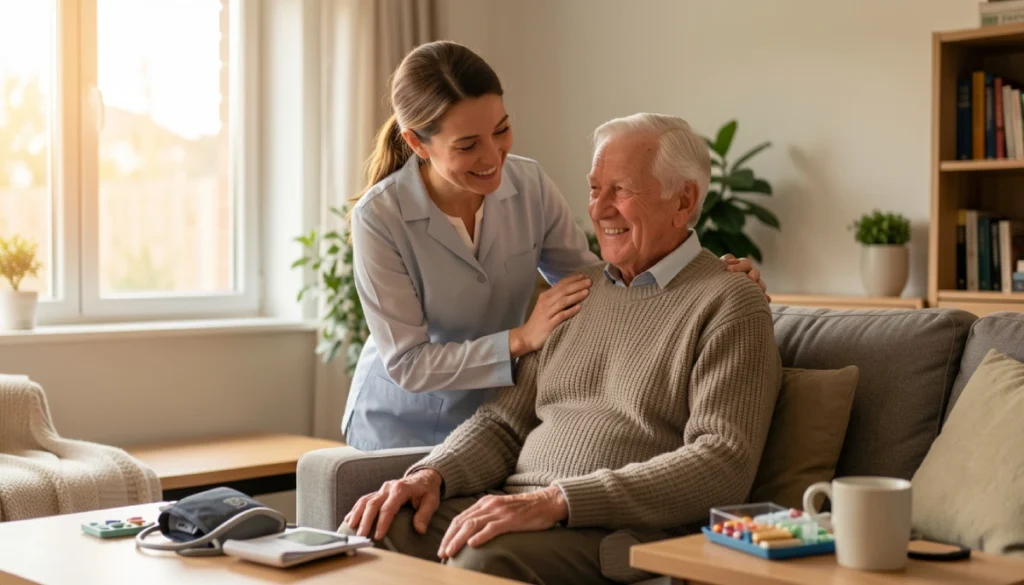
The baby boomer effect is no longer a forecasting model. More people are now older than in previous generations. That’s a scary enough statistic, but when you consider that the one-year period from January 1st, 2011, to January 1st, 2012, marked the first year that the very first baby boomers reached retirement age, it becomes clear that the healthcare demands of the boomers are here to stay.
Why home-based care is where the growth is
Healthcare work used to be concentrated in hospitals and long-term care settings, but not anymore. The desire to age in place – that is, for older adults to stay at home rather than move into institutional settings – has pushed the epicenter of care delivery out to people’s homes.
This shift matters to job seekers because it means that job growth isn’t occurring in a few large institutions; instead, it’s dispersed across communities, neighborhoods, and homes. Home health aides, personal care assistants, and companion caregivers are in demand in nearly every zip code.
A labor shortage that works in workers’ favor
The labor market for senior care is always growing as more people are of an older age, but the supply of care workers isn’t growing at the same pace. While this means there isn’t necessarily enough carers to deal with the aging population, it does mean that job seekers in this market are in a better position to negotiate wages, benefits, and their hours.
There are more caregiving jobs available than there are professionals to take them, which has pushed employers to compete on wages, benefits, scheduling flexibility, and advancement pathways. Entry-level roles that might have stagnated in a saturated market are now offering structured training programs, mentorship, and clear paths toward certification and specialization.
The labor market here is not some vague, uncertain space full of maybes. There is a well-documented shortage in a sector where the work simply cannot be shipped overseas or handed off to a machine. When someone needs help getting out of bed, getting dressed, or making it safely to the bathroom, no app or algorithm can step in. It takes a real person, physically there, doing the work. The same applies to companionship. It is easy to dismiss it as a bonus or a soft extra, but the research is catching up with what most caregivers already know. Being present with someone consistently and reliably has a measurable impact on health outcomes. It is a clinical need, not a luxury.
Specialization is creating genuine career ladders
The senior care workforce has long been viewed as a low-paid and undervalued segment of the economy. Not only has that led to a staggering shortage of workers in the field, but it also makes competing for the best talent extremely difficult.
However, as the pandemic has underscored the extraordinary role that these frontline workers play in supporting vulnerable seniors, and as demand continues to outstrip supply for workers in this sector, the perception of caregiving as low-skilled labor is beginning to shift.
Specialization is driving a wedge in the labor market, and caregivers who possess experience or training in areas such as caring for those with dementia and Alzheimer’s, chronic disease management, and palliative care are able to command higher hourly rates for their expertise. Caregivers paired with assistive technologies in the home who are comfortable monitoring and interpreting data generated by these devices are also more attractive prospects for employers.
The case for purpose alongside stability
Jobs in the healthcare sector are often emotionally demanding and can be quite draining. Typically speaking, the environment is fast-moving, and the stakes can vary from very remedial to life-changing. On the other hand, care for seniors isn’t described in the same terms.
While the work is demanding, as evidenced by caregiver burnout in the sector, responsible organizations make an effort to invest in appropriate support systems, reasonable workloads, and frequent follow-ups. But work demand is what also gives senior care work its true meaning. The relationship established between a caregiver and an elderly patient is developed over weeks and months and usually becomes one of the patient’s most stable human relationships – and this is a connection that can not be matched or replicated by any computer program.
Research done on senior health has begun to help caregivers understand that care isn’t purely about meeting medical needs either. Treating seniors like humans and addressing social health issues is also key. It’s now well understood that things like loneliness or isolation can cause physical health problems to take shape. Because of this, caregivers now go beyond just providing check-ups and ensure that seniors are okay in multiple ways.
Where this leaves job seekers
The long-term industry of senior care is not a temporary growth story. The population structure that drives its demand does not reverse; it compounds. Workers who enter this space now position themselves in an industry that will need more people, more specialization, and more skilled leadership for the next thirty years.
Right now, it’s an in-demand position with very few barriers to entry and many ways to advance – who can say what this career path will look like in times when there are more people needing care than now?
