
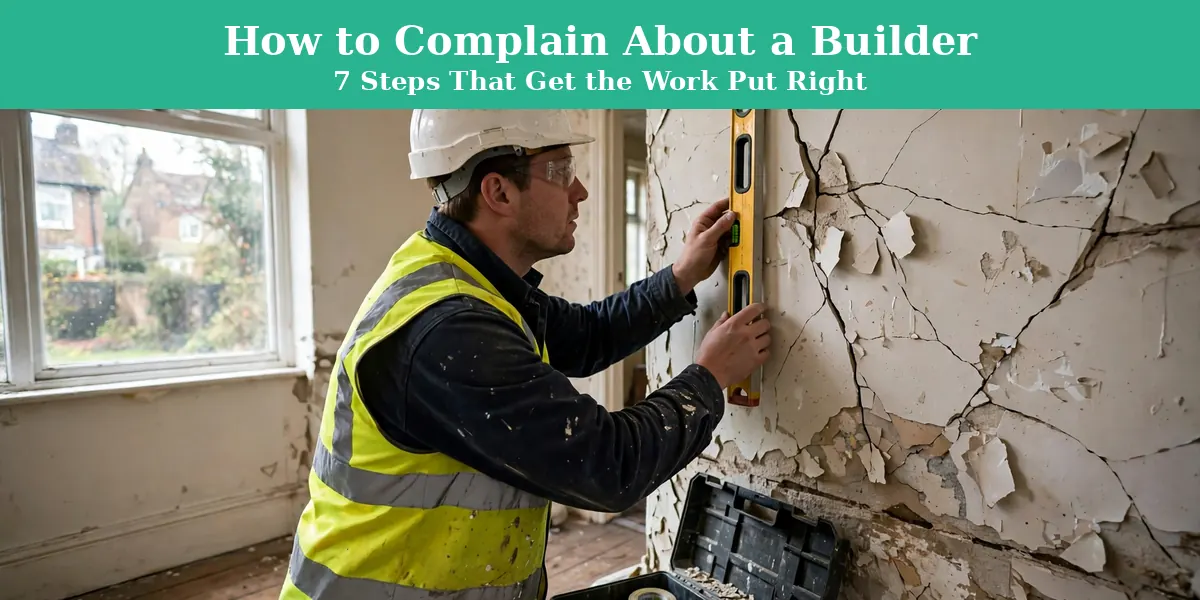
A builder has left your kitchen half tiled and the bill fully paid. You feel stuck between paying more and living with the mess. This guide shows how to complain about a builder, step by step. It covers your rights, your letter, and court if it comes to that.
You do not need a solicitor to start. Most builder disputes settle once the complaint is put in writing. The law is on your side when the work falls short.
What are your rights when a builder does bad work?
Under the Consumer Rights Act 2015, a builder must work with reasonable care and skill. Materials must match their description and be fit for their purpose. If the work falls short, ask for a repeat performance or a price cut. You can also claim the cost of a proper fix.
These rights apply whether the deal was written or spoken. A builder cannot sign them away in small print. The same Act covers plumbers, electricians and decorators too.
A fair price is part of the deal too. If no price was fixed, you owe only a fair sum for the work done. A builder cannot charge a wild sum for a small job.
At a glance
| Stage | Your move |
|---|---|
| Speak up | Put the fault in writing, with photos and a deadline |
| Give a chance | Let the builder return and put the work right |
| Gather proof | Quotes, an expert report and all your receipts |
| Escalate | Letter before action, a scheme, Trading Standards or court |
What counts as poor workmanship?
Poor workmanship means work below the standard of a skilled trader in that trade. It covers faults you can see and faults that show up later. The test is the trade standard, not your taste in style.
| Fault | Example |
|---|---|
| Unfinished work | A bathroom left half tiled with no shower fitted |
| Defective work | A leaking roof or a wall that cracks within weeks |
| Wrong materials | Cheap tiles used where the quote named a dear brand |
| Late work | A two week job that drags on for two months |
| Overcharging | A final bill far above the fixed price agreed |
Small snags do not count as poor workmanship on their own. A paint scuff or a loose screw can be fixed in one visit. The law looks at the whole job. Our guide to fixing a squeaky door shows how one small job is done.
How to complain about a builder in 7 steps
A calm written complaint beats an angry phone call. Each step in how to complain about a builder builds your proof file. Follow them in order and keep copies of all you send.
- Tell the builder in writing what is wrong, with dates and photos.
- Set a fair deadline for a reply, such as two weeks.
- Give the builder a fair chance to return and fix the work.
- Ask other traders what the repair should cost.
- Ask an independent expert for a report if the fault is technical.
- Send a letter before action if the builder still does nothing.
- Use a dispute scheme, Trading Standards or court as a last step.
Keep every message, photo and receipt in one folder. Dates matter, so note when each fault first showed. A clear timeline makes your case easy to follow.
Do not let another trader fix the work too soon. The law expects you to let them try. If you skip that step, you may lose the right to claim the repair cost.
What should your complaint letter say?
Your letter should state the fault, the fix you want and a date for a reply. It should cite the Consumer Rights Act 2015 and the price you paid. Short, firm and polite beats long and angry every time. A good letter sits at the heart of how to complain about a builder.
- Your name, address and the date of the letter.
- The date the work started and what was agreed.
- Each fault, listed one by one, with photos attached.
- The remedy you want: a repair, a redo or a refund.
- A deadline for a reply, often 14 days.
- A note that you will take the matter further if needed.
Send the letter by email and keep a copy. Email gives you proof of the date you sent it. A signed-for letter works too if the builder ignores email.
If the builder still does nothing, send a letter before action. This letter sets out the claim sum and gives a last date to pay or fix. Courts expect this step before any claim is filed.

What if the builder refuses to fix the work?
A refusal moves your complaint to the next stage. Trade bodies, dispute schemes and Trading Standards can all help. The right route depends on who the builder is and what you paid.
Check first if the builder belongs to a trade body. The Federation of Master Builders and TrustMark both run dispute schemes for members. Gas Safe Register and NICEIC cover gas and electrical work in the same way.
Mediation can settle a dispute without a hearing. A neutral third party helps both sides reach a deal. If the builder has vanished or gone bust, ask your bank about a chargeback at once. New home buyers can also use the New Homes Ombudsman.
How to get your money back
Payment method matters more than most people think. A credit card gives you a strong legal route to a refund. A debit card gives you a weaker, time-limited one.
- Section 75: paid by credit card, job cost £100 to £30,000, card firm shares liability.
- Chargeback: paid by debit card, ask your bank within 120 days of the payment.
- PayPal: buyer protection may cover the payment if you used it.
- Insurance: check your home policy for legal expenses cover.
Section 75 comes from the Consumer Credit Act 1974. It makes the card firm jointly liable when the trader fails you. The claim goes to the card firm.
If the card route fails, the Financial Ombudsman Service can step in. It is free for consumers and its rulings bind the firm. A court claim stays open as a last route if all else fails.
When to take a builder to the small claims court
Court is the last step in how to complain about a builder. Use it when letters, schemes and mediation have all failed. Most builder claims fit the small claims track, which is built for people without a solicitor.
| Claim amount | Court fee |
|---|---|
| Up to £300 | £35 |
| £300.01 to £500 | £50 |
| £500.01 to £1,000 | £70 |
| £1,000.01 to £1,500 | £80 |
| £1,500.01 to £3,000 | £115 |
| £3,000.01 to £5,000 | £205 |
| £5,000.01 to £10,000 | £455 |
| £10,000.01 to £200,000 | 5% of the claim |
The small claims limit is £10,000 in England and Wales. Scotland sets its own limit at £5,000, and Northern Ireland at £3,000. You may get the fee back if you win. Low earners can ask for help with fees.
The court will first offer free mediation by phone. If that fails, a judge hears the case in a short hearing. You can claim 8% yearly interest on the sum owed. The GOV.UK guide to court claims lists the full fee table.

How to avoid a builder dispute next time
The best complaint is the one you never need to make. A written quote and a staged payment plan stop most rows before they start. Spend an hour on the deal and save weeks of stress.
- Get a written quote that lists each job and its price.
- Agree staged payments, with the last sum held back till the snags clear.
- Ask for proof of insurance and trade body membership.
- Photograph the work at each stage, from start to finish.
- Agree a snag list for faults found at the end.
Check the trader on review sites and ask past clients for views. A cheap quote can cost more when the work needs a redo. Our guide to saving money on home renovations shows where a fair price sits.
Put the finish date in writing, with a fix for late work. A clear deal gives both sides a fair test. If a trader will not put it in writing, walk away and find one who will.
Questions readers ask about builder complaints
Can I refuse to pay a builder for bad work?
Hold back a fair sum for the faulty part only. A full refusal can put you in breach of the deal. Pay for the sound work, note the fault in writing, and give a date.
How long do I have to complain about a builder?
You have six years from the breach to claim in England and Wales. A contract made by deed gives you twelve years. Act fast, since proof gets thin as months pass.
Can I claim compensation for stress caused by a builder?
Courts rarely pay for stress in a building row. They pay for the repair cost and the loss in value of the home. Keep your claim to real sums you can prove with quotes.
What if the builder has gone out of business?
Check any trade guarantee and your home insurance first. A trade body scheme may still pay if the builder was a member. Report the firm to Trading Standards so the next homeowner is warned.
Do I need a solicitor for a small claim against a builder?
No. You can file the claim and present your own proof. The court fee depends on the sum you claim. A solicitor can still help with a tricky case, but most people manage on their own.
Can I get the work fixed by someone else and claim the cost?
Yes. Get two or three quotes for the repair first, then hire the new trader. Send the first builder the new invoice and claim the sum in writing. A court can order the sum back if the builder will not pay.
Start with a letter, not a shouting match
Most builder rows end with a letter. A clear note, a fair deadline and firm proof move most traders to act. Your calm paper trail is the best tool in how to complain about a builder.
If the builder will not budge, use the routes in this guide one by one. Each step costs little and keeps your case strong. This guide gives general information, not legal advice. Speak to a qualified solicitor if the sums are large or the case is complex.
Read our UK consumer rights guide next for the refund rules behind your claim. Then write your letter today, while the facts are fresh. A firm first letter often ends the whole row.
