
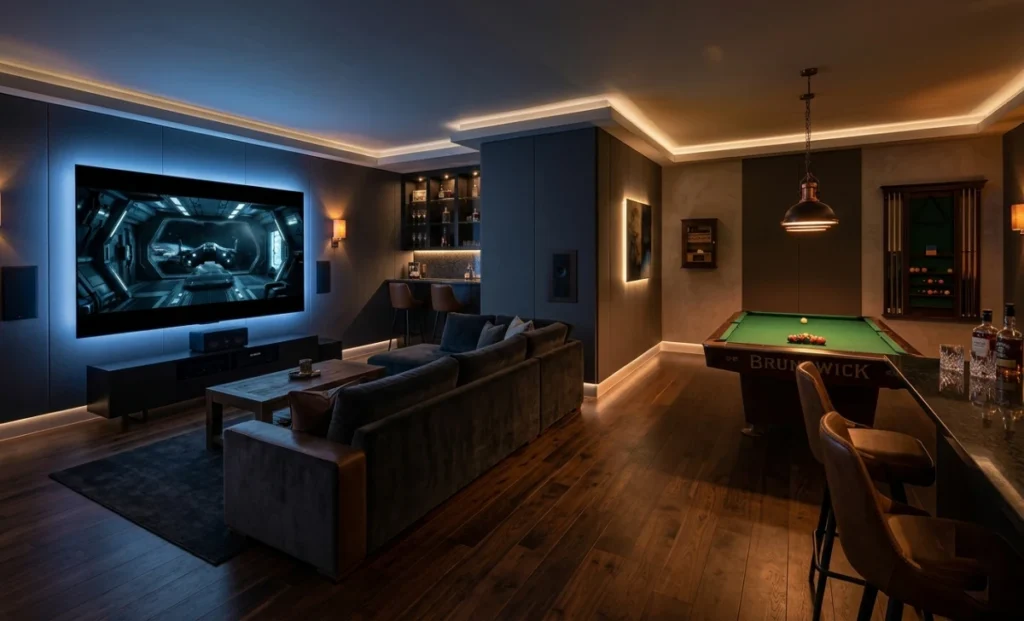
A dedicated entertainment room in your house that’s optimized only for one type of entertainment is a room that’s underperforming. The best entertainment spaces expertly thread the needle between screen-based immersion and physical, social play. And trust us, getting that balance just right requires so much more than buying a bigger TV.
Lay Out Zones Before You Buy Anything
The biggest mistake that many people make is buying equipment before deciding how they want the space to function. You need a floor plan that clearly defines two separate activity zones: a digital zone for screens and gaming, and a tactile zone for either a billiards table or tabletop games.
And those zones need easy and obvious traffic flows between them. The guy walking from the couch to the billiard table shouldn’t walk through the other guy’s screen. A diagonal layout often takes care of this naturally – screen on one wall, billiard table angled toward the opposite corner – in rooms over 400 square feet. In smaller spaces, furniture placement becomes your tool for creating that separation without building walls.
Creating these zones doesn’t necessarily mean using permanent structures. Area rugs, pendant lighting positioned over specific surfaces, and furniture orientation all clearly say “this is a different space” without walls.
Build A Lighting System With Multiple Scenes
Uniform lighting that is too bright is the enemy of atmosphere in a movie room or while playing pool. What you do want is appropriate task lighting, ambient lighting, and bias lighting, and the key to achieving the perfect atmosphere in one room is through smart control of all three with a lighting control system and some carefully placed fixtures.
A well-designed lighting control system lets you save and recall multiple “scenes” – pre-programmed combinations of light levels and colours tailored to different activities. Movie night might call for deep-dimmed ambient lighting, a soft bias glow behind the screen to reduce eye strain, and task lights fully off. Pool or snooker, on the other hand, demands a focused overhead light above the table at full brightness, while ambient and bias lighting drop back to set a moody, pub-like tone.
With a single tap on a keypad, app, or voice command, you can shift instantly from one scene to the next – no fumbling with multiple switches or dimmers, just the right light for the right moment.
Choose The Right Centerpiece For The Tactile Zone
The pool table will be the center of the physical play space, and you’ll want to get its dimensions right before anything else becomes immovable. A 7-foot table will fit in most residential rooms, but an 8-foot table plays better and requires about 5 feet of clearance around it for a normal cue stroke – that’s non-negotiable other than regular bruised knuckles.
As for quality, buy from a pro. A Swiftflyte billiard shop is going to have commercial-quality tables and products that can endure the telltale bruises from use that will come from missing an easy shot after taking 15 times in a row. The cloth wears, and the cushions lose the bounce factor over time, and the entire thing gets tilted in someone’s favor.
Invest In Audio That Doesn’t Create Conflict Between Zones
The biggest issue with multi-purpose rooms is sound. If you have a Dolby Atmos setup tuned to your screen zone, it’s going to be way too loud in the billiard area, making conversation impossible. Similarly, the sound of the game or match will interfere with your movie-watching experience.
The solution isn’t turning the whole thing down. That’ll just mean the screen area is too quiet. Instead, you need creative use of technology and materials. Ceiling mounts direct the sound towards the listening area and keep it there. Acoustic tiling on the walls stops it from bouncing around and drifting.
Keep how you will use these zones in mind. You can add a Bluetooth receiver to a set of speakers beside the pool table, for example. This way, the sound that helps the players concentrate doesn’t interfere with the film that the rest of the room is enjoying.
Make The Furniture Work Harder Than It Looks
Seating that can be easily rearranged for different numbers and sizes of players, such as bean bags, ottomans, or individual chairs, may be the best choice. If possible, include seating with hidden storage to store games or supplies – an added bonus.
Ottomans with trays can serve as small tables, or even extra seating, if necessary. Choose easily movable pieces that can be easily pushed out of the way or turned to face the main gaming area. If the gaming room is also used for other purposes, make sure the seating is easy to store, if possible.
Future-Proof The Infrastructure Before The Walls Go Back Up
If you’re building or remodeling the room, this is when you put in conduit to manage cables and floor outlets right in the middle of the room. A billiard table area with no power access nearby will have cords running everywhere.
Wi-Fi 6 routers are responsible for making sure you have good coverage everywhere in both zones. The devices matter, and high-powered devices spread all over the room streaming, playing games, and controlling smart lighting is a great test for any network. Dedicated Ethernet drops for the fixed screen setup ensure that there’s no delay introduced if a wired connection works best.
The global smart home market is growing at a compounded 27.07% yearly rate until 2030 (Grand View Research), and home entertainment rooms are one of the best proving grounds for this technology. When you can work the AV, lights, and thermostat from a single app, you’ll truly start using all these features long term.
A good entertainment room doesn’t focus on one thing to the exclusion of others. It effortlessly lets you switch from movie to game to TV show and back again. And that’s what will get the most use year after year.
