
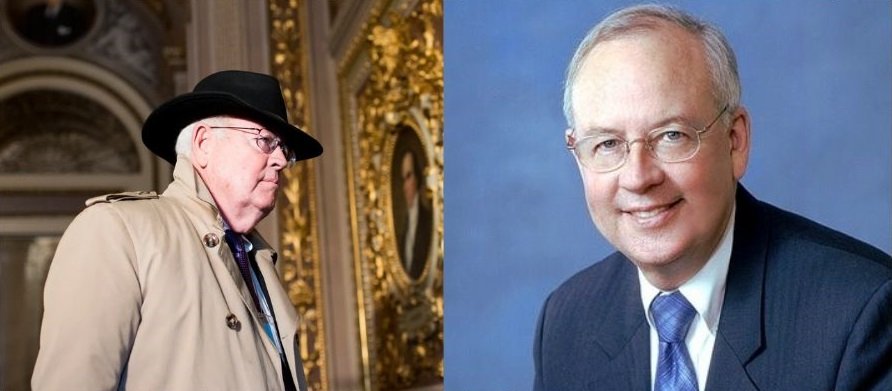
Ken Starr didn’t set out to become one of the most polarizing legal figures in American history — but by the time he was done, he’d dragged a sitting president through the most scandalous investigation the country had ever seen, and nobody would ever look at the White House the same way again.
Here’s the thing most people forget: Ken Starr was a mild-mannered, Bible-selling preacher’s kid from a small Texas town. He wore his faith on his sleeve and built his reputation as a steady, careful legal mind. Yet this was the same man whose 445-page report — packed with details so explicit it practically melted the printing press — landed on every doorstep in America in 1998. How does that happen? How does a quiet judge from Vernon, Texas, end up as the prosecutor who brought a president to his knees? That’s the story worth telling, and it’s a lot more complicated than the headlines ever let on.
This article walks through the full arc of Ken Starr’s life from his early years as a law student to his time arguing cases before the Supreme Court, from the Whitewater swamps of Arkansas to the halls of the U.S. Senate, and from the ruined halls of Baylor University all the way back to a final Washington courtroom where he defended the very kind of president he once hunted.
Ken Starr’s Early Life: A Preacher’s Son With Big Ambitions
Ken Starr was born Kenneth Winston Starr on July 21, 1946, in Vernon, Texas a dusty border town sitting right where Texas and Oklahoma shake hands. He grew up in San Antonio, raised in a household built on faith and discipline. His father was a Church of Christ minister, and that religious foundation shaped everything about how Starr would later carry himself: serious, principled, and absolutely convinced he was on the right side of things.
To pay for college, young Ken didn’t flip burgers or bag groceries — he went door-to-door selling Bibles. You honestly couldn’t write a more on-the-nose origin story for a man who would later quote scripture while dismantling a president’s reputation. He earned his B.A. from George Washington University in 1968, picked up an M.A. from Brown University in 1969, and then grabbed his Juris Doctor from Duke University School of Law in 1973. That’s a staircase of prestigious degrees, and Starr climbed every step with quiet determination.
From the jump, it was clear Ken Starr wasn’t going to end up as a small-town attorney handling traffic tickets. His political leanings ran Republican, which would later fuel one of the loudest criticisms of his entire career. But in those early days, he was just a sharp young lawyer with a crisp résumé and a lot of ambition.
Ken Starr’s Rise Through Government: From Clerk to Solicitor General
After law school, Ken Starr clerked for Judge David W. Dyer on the Fifth Circuit from 1973 to 1974, and then landed perhaps the most prestigious clerkship in American law — working directly under Chief Justice Warren Burger of the U.S. Supreme Court from 1975 to 1977. Think of that experience as drinking from a fire hose of constitutional law every single day. Starr soaked it all in.
By 1981, he was counselor to the U.S. Attorney General, a role that put him inside the engine room of American law enforcement. In 1983, President Ronald Reagan — recognizing a reliable conservative legal thinker when he saw one — appointed Starr to the U.S. Circuit Court of Appeals for the District of Columbia Circuit. Starr was just 37 years old. That court is widely considered the second most powerful in the country, and Starr held that seat until 1989.
Then came his biggest pre-Whitewater role: U.S. Solicitor General under President George H.W. Bush, serving from 1989 to 1993. The Solicitor General is the lawyer who argues the federal government’s cases before the Supreme Court. It’s a rare, pressure-filled position, and Starr reportedly argued 25 to 36 cases before the justices during his tenure. By the time he left government in 1993, Ken Starr was being whispered about as a potential Supreme Court justice himself.
| Ken Starr Career Timeline | Details |
|---|---|
| Born | July 21, 1946, Vernon, Texas |
| Education | B.A. GWU (1968), M.A. Brown (1969), J.D. Duke (1973) |
| Supreme Court Clerkship | Chief Justice Warren Burger (1975–1977) |
| D.C. Circuit Judge | 1983–1989 (appointed by Reagan, age 37) |
| U.S. Solicitor General | 1989–1993 (under President George H.W. Bush) |
| Independent Counsel Named | August 1994 |
| Starr Report Released | September 9, 1998 |
| Resigned as Independent Counsel | 1999 |
| Dean, Pepperdine Law | 2004–2010 |
| President, Baylor University | 2010–2016 |
| Defended Trump in Impeachment | January 2020 |
| Death | September 13, 2022, Houston, Texas (age 76) |
Ken Starr and Whitewater: The Investigation That Opened a Pandora’s Box
In August 1994, Ken Starr accepted the job of independent counsel to investigate what was being called the Whitewater affair. This was a failed real estate investment that Bill and Hillary Clinton had made years earlier in Arkansas, involving a development called Whitewater Estates. On the surface, it looked like a boring land deal gone bad. What nobody realized at the time was that Whitewater was just the front door — and behind it sat a house full of secrets nobody was prepared to handle.
Starr’s investigation chewed through years of financial records, deposed dozens of witnesses, and ultimately resulted in 11 convictions, including Clinton associates James McDougal and his wife Susan McDougal. James McDougal became a government witness before dying in prison in 1998. Susan McDougal famously refused to cooperate and served 18 months for contempt — she became a kind of folk hero to Clinton supporters.
But Starr didn’t stop at Whitewater. His mandate expanded like a balloon. He looked into the mysterious death of White House counsel Vince Foster, a close Clinton friend who was found dead in a Virginia park in July 1993. After a lengthy review, Starr concluded what previous investigations had already found: Foster’s death was a suicide. The matter was closed, though conspiracy theories never fully died.
He also investigated Travelgate — the sudden firing of longtime White House travel office employees — and Filegate, which involved the improper transfer of FBI background files on Republican officials to the Clinton White House. Each new thread led to another. By the late 1990s, Ken Starr’s investigation had become a sprawling machine that critics said was wildly out of control and supporters said was simply doing its job.
Ken Starr and the Monica Lewinsky Scandal: When Everything Exploded
Nobody — not even Starr himself, probably — could have predicted where the investigation would end up. In 1997, former Arkansas state employee Paula Jones was pursuing a sexual harassment lawsuit against President Clinton. During pretrial depositions in January 1998, Clinton was asked under oath about his relationship with Monica Lewinsky, a 24-year-old White House intern. He denied it. Flatly. On the record.
That denial turned out to be the crack in the dam. Linda Tripp, a former White House staffer who had been secretly recording phone conversations with Lewinsky, brought her tapes to Starr’s team. Those tapes suggested Lewinsky had been coached to lie about the affair in the Jones lawsuit. With approval from Attorney General Janet Reno, Starr expanded his investigation to cover the Lewinsky matter.
What followed was one of the most watched legal dramas in U.S. history. Starr’s team seized Lewinsky’s computer hard drive and email records. Clinton’s secretary, Betty Currie, was interviewed about whether the president had coached her on what to say. The White House denied everything, with Clinton delivering his famous, jaw-dropping line during a deposition: “It depends upon what the meaning of the word ‘is’ is.” That single sentence became shorthand for a presidency under siege.
By August 1998, the jig was up. Clinton went on national television and publicly admitted he had an “inappropriate relationship” with Lewinsky. He’d lied under oath. He’d lied to the American public. And Ken Starr had the receipts.
| Key Dates in the Clinton-Lewinsky Investigation | Event |
|---|---|
| January 17, 1998 | Clinton denied relationship with Lewinsky under oath |
| January 1998 | Linda Tripp brought tapes to Starr’s office |
| August 1998 | Clinton publicly admitted to the relationship |
| September 9, 1998 | Starr Report delivered to Congress |
| September 11, 1998 | Starr Report released to the public |
| October 8, 1998 | House authorized impeachment inquiry |
| December 19, 1998 | Clinton impeached by the House |
| February 12, 1999 | Clinton acquitted by the Senate |
The Starr Report: 445 Pages That Shocked a Nation
On September 9, 1998, Ken Starr delivered his report to Congress. Two days later, it was released to the public. Nothing quite like it had ever landed in American political life before. The document ran 445 pages and laid out 11 possible grounds for impeachment: perjury, obstruction of justice, witness tampering, and abuse of presidential power. The evidence Starr attached was staggering — it included taped phone calls, grand jury testimony, email records, and a now-infamous blue dress that contained DNA evidence of a sexual encounter.
The report read like a courtroom brief wrapped in the plot of a tabloid novel. Critics blasted Starr for including far more explicit detail than necessary, arguing he was less interested in sober legal argument and more interested in humiliating the president. Supporters said the explicit details were legally relevant because they proved Clinton had lied under oath in a civil case. Both sides had a point, which is part of what made the whole episode so maddening.
The American public, for its part, was absolutely riveted and deeply disgusted — often at the same time. The Starr Report became a commercial bestseller when it was published in book form. Time magazine named both Clinton and Starr as its Men of the Year for 1998. That pairing said everything about how tangled their fates had become.
Ken Starr and the Clinton Impeachment: Historic, Divided, and Ultimately Unsuccessful
Armed with Starr’s report, the Republican-controlled House of Representatives moved fast. On October 8, 1998, the full House voted to authorize an impeachment inquiry. By December 19, 1998 — just days before Christmas — the House voted to impeach Bill Clinton on two articles.
Article I, charging Clinton with perjury before the grand jury, passed 228–206. Article III, charging obstruction of justice, passed 221–212. Two other articles — perjury in the Jones case and abuse of power — were rejected. Clinton became only the second president in American history to be impeached by the House of Representatives. Andrew Johnson had been the first, back in 1868.
Then the matter moved to the Senate, where Chief Justice William Rehnquist presided over the trial from January 7 through February 12, 1999. The math was never going to work for conviction. Under the Constitution, it takes a two-thirds majority — 67 senators — to remove a president from office. The Senate voted 45–55 to convict on the perjury charge and split exactly 50–50 on the obstruction charge. Clinton was acquitted on both counts and served out the remainder of his second term.
| Impeachment Vote Breakdown | For | Against |
|---|---|---|
| Article I – Perjury (Grand Jury) | 228 | 206 |
| Article II – Perjury (Jones Case) | 205 | 229 |
| Article III – Obstruction of Justice | 221 | 212 |
| Article IV – Abuse of Power | 148 | 285 |
| Senate: Article I (needed 67) | 45 | 55 |
| Senate: Article III (needed 67) | 50 | 50 |
The Controversy Around Ken Starr: $70 Million and No Conviction
The criticism of Ken Starr didn’t wait politely for the Senate verdict. It had been building for years. The entire independent counsel investigation cost American taxpayers roughly $70 million before it was all said and done — a staggering number that Democrats hammered repeatedly. For all that money, they pointed out, the president stayed in office.
There were also serious accusations that Starr’s investigation was politically driven from the start. He was a Republican, appointed during a Democratic presidency, investigating a Democratic president. His critics argued he ran the probe like a partisan hit job dressed up in legal clothing. Then there was the matter of his outside work — Starr continued to represent private clients at the powerful Washington law firm Kirkland & Ellis even while serving as independent counsel, which looked terrible regardless of whether it was technically allowed. He eventually took an unpaid leave from the firm, but the damage to his image was done.
Starr’s office was also accused of leaking sealed grand jury material to the press, though those accusations were never conclusively proven. The media, for their part, fed on every scrap. The coverage of the Lewinsky scandal was relentless, suffocating, and in many ways unprecedented — it permanently changed how Washington journalism worked.
In 1999, Starr resigned as independent counsel. His deputy, Robert W. Ray, took over and continued the investigation until 2002. In the end, no criminal charges were ever filed against Bill or Hillary Clinton related to any of the original investigations.
Ken Starr After the Clinton Years: From Dean to President to Disgrace
After the tornado of the 1990s, Ken Starr tried to rebuild a quieter life. He returned to private legal practice and eventually became dean of Pepperdine University’s Caruso School of Law in 2004, a position he held until 2010. By most accounts, he was effective in that role, helping raise the school’s national profile.
In 2010, Starr moved to Waco, Texas, to become President of Baylor University, a prominent Baptist institution. He served as president until 2016 and concurrently held the title of Chancellor from 2013 to 2016. Things looked good on paper — enrollment was up, the football team was winning, and Baylor was raising its national academic reputation. But underneath all of that was something rotten.
In 2016, an independent investigation concluded that Baylor University had seriously mishandled multiple sexual assault cases, many of them involving members of the football program. The report was devastating. It accused the university of prioritizing athletic success over the safety of sexual assault survivors. Ken Starr — the man who had spent years investigating a president for lying about a sexual encounter — was removed as president and resigned as chancellor. The irony was so sharp it practically drew blood.
In 2018, Starr published “Contempt: A Memoir of the Clinton Investigation,” his personal account of those turbulent years. He expressed regret about some aspects of how the investigation had unfolded, though he never fully backed away from the central conclusions of his report.
Ken Starr and the Trump Impeachment: A Full Circle Moment
Perhaps the strangest chapter of Ken Starr’s later career came in January 2020 when he joined the legal defense team for President Donald Trump during Trump’s first Senate impeachment trial. The same man who had argued that Bill Clinton’s dishonesty was an impeachable offense was now arguing that a president’s conduct didn’t rise to the level of impeachment. Critics nearly lost their minds. Supporters said he was simply doing his job as a defense attorney.
Trump was acquitted, and Starr’s role in the trial added one more layer of complexity to an already difficult legacy. Commentators noted the “eerie echoes” between the Lewinsky investigation and the various probes into Trump — the same arguments about partisan motivation, the same debates about prosecutorial overreach, the same exhausted American public wondering when the whole show would ever end.
Ken Starr’s Death and Legacy: A Complicated Final Chapter
Ken Starr died on September 13, 2022, in Houston, Texas, from complications following surgery. He was 76 years old. Tributes poured in from both sides of the political spectrum, though they were predictably mixed. Senate Minority Leader Mitch McConnell remembered him as “a brilliant litigator, an impressive leader, and a devoted patriot.” Monica Lewinsky, whose life had been upended by the investigation, tweeted simply that she was sure “many can understand” how she felt about the news.
Author Ken Gormley, who wrote “The Death of American Virtue” about the Starr-Clinton conflict, put it as plainly as anyone: “Half the country loved him. The other half loathed him.”
That split verdict might be Ken Starr’s truest legacy. He was, without question, one of the most consequential legal figures in modern American history. He helped trigger the first presidential impeachment in over a century. He fundamentally changed how Americans think about the relationship between a president’s private life and public accountability. And yet, the $70 million investigation that consumed five years of national life ended without a single criminal conviction of the man at the center of it all.
