
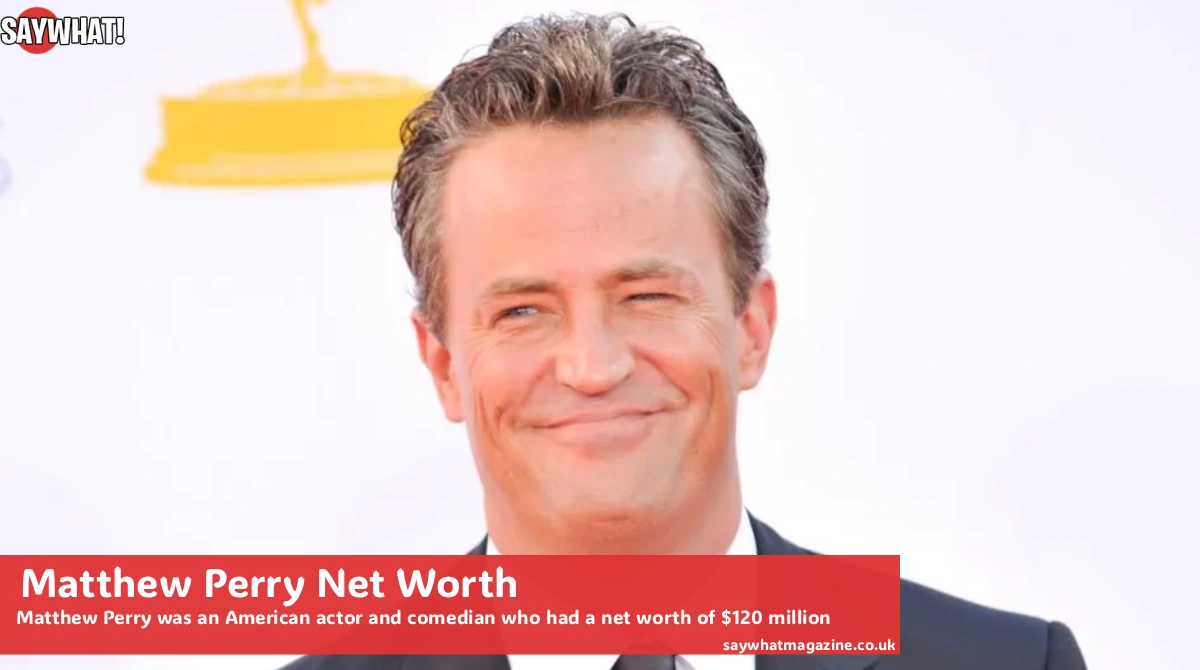
When Matthew Perry passed away in October 2023, the world mourned the loss of one of television’s greatest comedic talents. But behind the quick wit and razor-sharp delivery of Chandler Bing lay something equally impressive: a financial legacy worth an estimated $120 million. Perry’s journey from a struggling young actor to one of Hollywood’s wealthiest television stars is a story of talent meeting strategy, and of collective power reshaping an entire industry’s pay structure.
This is not simply the story of a man who got lucky with a hit show. Matthew Perry net worth reflects decades of smart negotiation, savvy real estate investments, the foresight to secure long-term syndication rights, and the courage to turn personal struggle into a bestselling memoir. Long after the last episode of Friends aired, Perry continued to earn millions each year — a testament to the enduring power of the show and the business acumen that helped him maximize every opportunity it presented.
The Friends Era: A Salary Revolution Season by Season
In 1994, Matthew Perry stepped onto the set of Friends as a relatively unknown actor. His starting salary reflected that status: a modest $22,500 per episode in Season 1. For context, this was a reasonable sum for an emerging television actor, but it bore no resemblance to what was coming. As Friends became one of the most-watched shows in American television history, its cast recognized their growing leverage and chose to use it in an unprecedented way.
By Seasons 3 and 4, salaries had climbed to approximately $75,000 per episode. Season 5 saw another jump to around $100,000. But the truly historic moment came when all six core cast members — Perry, Jennifer Aniston, Courteney Cox, Lisa Kudrow, Matt LeBlanc, and David Schwimmer — decided to negotiate as a single unit rather than compete against each other.
This collective bargaining strategy was virtually unheard of in Hollywood at the time. Networks routinely played cast members against one another, offering higher salaries to perceived fan favorites in exchange for exclusivity. By presenting a united front, the Friends cast eliminated this tactic entirely. The result was staggering: by Seasons 9 and 10, all six stars were earning $1 million per episode — making them, at the time, the highest-paid television actors in history.
Across the show’s ten seasons and 236 episodes, Matthew Perry earned approximately $90 million in base salary alone. This figure, while extraordinary, was only the beginning of the Matthew Perry net worth story.
The Gold Mine of Syndication and Royalties
Perhaps the most financially significant achievement of Perry’s career was not what he earned during production, but what he secured for afterwards. Along with his co-stars, Perry negotiated for “backend points” — a percentage of the show’s profits from syndication and licensing deals. This arrangement, rare for television actors at the time, would prove to be one of the most lucrative deals in entertainment history.
Friends did not fade into obscurity after its 2004 finale. Instead, it became a cultural institution that seemingly never stopped airing. The show generates an estimated $1 billion annually for Warner Bros. through a complex web of syndication deals, international broadcast rights, and streaming agreements with platforms like Max and Netflix. Netflix famously paid $100 million for a single year of U.S. streaming rights in 2019, and the show has remained one of the most-watched titles on streaming platforms worldwide.
For Perry and his castmates, this meant a royalty stream that functioned almost like a pension — except one that paid between $10 million and $20 million per year. Industry analysts estimate that Perry’s backend percentage generated this income annually from 2004 until his death, meaning that over approximately 19 years, his syndication earnings alone could have exceeded the value of his entire on-screen salary. This is the engine behind the remarkable Matthew Perry net worth figure.
Real Estate Ventures and Luxury Assets
Beyond television, Matthew Perry was a sophisticated participant in the Los Angeles real estate market. His most notable property was a 9,300-square-foot penthouse in Century City — a sprawling “mansion in the sky” that featured panoramic views of the city and high-end finishes throughout. Perry listed the property in 2017 for $35 million, eventually selling it in 2021 for $21.6 million, a transaction that, despite falling short of the original asking price, represented a significant return on his investment.
Perry also owned a charming cottage in the Pacific Palisades neighborhood of Los Angeles, a community known for attracting entertainment industry professionals seeking a quieter, more residential atmosphere. Additionally, he maintained a beachfront property in Malibu, one of Southern California’s most prestigious coastal addresses.
These real estate holdings served a dual purpose. On one hand, they provided Perry with comfortable residences befitting his status. On the other, they acted as a hedge against market volatility and career downturns, ensuring that his wealth remained tangible and appreciating even during periods when acting work was less consistent. Real estate is a critical but often overlooked component of the Matthew Perry net worth equation.
Literary Success: Friends, Lovers, and the Big Terrible Thing
In November 2022, Matthew Perry published his memoir, Friends, Lovers, and the Big Terrible Thing, in which he wrote with extraordinary candor about his decades-long battle with addiction to alcohol and prescription drugs. The book was not merely a celebrity tell-all — it was a raw, often harrowing account of how fame, wealth, and personal demons can coexist in deeply uncomfortable ways.
The memoir debuted at number one on the New York Times Bestseller list and remained a commercial phenomenon for months. While the exact advance and royalty figures were not publicly disclosed, industry standards for a high-profile celebrity memoir from a major publisher suggest Perry likely received an advance in the range of several million dollars, with additional royalties generated by strong sustained sales across print, digital, and audiobook formats.
Beyond the financial return, the memoir cemented Perry’s legacy as more than an entertainer. By speaking openly about addiction — a subject still carrying considerable stigma — he transformed personal pain into public service. The book opened conversations, helped readers struggling with similar issues, and laid the philosophical groundwork for the foundation he would establish in his final years.
The Alvy Singer Living Trust and Estate Planning
Matthew Perry was thoughtful about protecting and distributing his wealth. The primary vehicle for this was the Alvy Singer Living Trust — a name drawn from Woody Allen’s neurotic protagonist in Annie Hall, which gives some insight into Perry’s sense of humor even in legal matters. By placing the majority of his assets into this living trust, Perry ensured that the bulk of his estate would transfer to his beneficiaries without passing through the public probate process.
Living trusts are a common estate-planning tool among high-net-worth individuals precisely because they offer privacy, efficiency, and the ability to transfer wealth directly and quickly. While probate proceedings became public record and revealed that Perry held over $1 million in additional personal property outside the trust, the vast majority of his $120 million estate was shielded from public scrutiny.
The beneficiaries of the trust include his parents — actor John Bennett Perry and journalist Suzanne Morrison — as well as his half-siblings and his former girlfriend Rachel Dunn. The inclusion of Dunn was a notable and touching detail, reflecting the personal relationships Perry valued in his later years.
Philanthropy: The Matthew Perry Foundation
One of the most meaningful dimensions of Matthew Perry’s financial legacy is not what he accumulated, but what he directed toward helping others. The Matthew Perry Foundation was established with a focused mission: to support individuals struggling with addiction and to fund substance abuse recovery programs. The foundation reflects the central preoccupation of Perry’s later life and his sincere commitment to ensuring that his own suffering could translate into relief for others facing similar struggles.
The foundation operates as a donor-advised fund, drawing support from his estate and ongoing residual income alongside private charitable contributions. Perry’s ongoing royalty stream, which continues to generate income even after his death, means the foundation has a durable financial basis to sustain its mission for years to come. In this way, his business acumen serves not just his heirs but a broader public good.
Matthew Perry Net Worth vs. Other Friends Co-Stars
To put the Matthew Perry net worth figure into context, it is useful to compare it with those of his Friends castmates. All six were paid equally during the show’s final seasons, so the primary differentiators have been post-Friends career choices, endorsements, and investment strategies.
- Jennifer Aniston (Rachel Green) is the wealthiest of the group, with an estimated net worth of approximately $320 million, bolstered by a hugely successful film career and major endorsement deals, including a long-running partnership with Aveeno.
- Courteney Cox (Monica Geller) has an estimated net worth of around $150 million, derived from continued acting work and significant real estate transactions.
- Lisa Kudrow (Phoebe Buffay) is estimated at approximately $90 million, reflecting a more selective post-Friends career trajectory.
- Matt LeBlanc (Joey Tribbiani) accumulated roughly $80 million, including earnings from the Joey spin-off series and the British motoring program Top Gear.
- David Schwimmer (Ross Geller) has an estimated net worth of around $100 million, with earnings from directing and theater work supplementing his Friends residuals.
Perry’s $120 million places him solidly in the middle of this remarkable cohort — a reflection of the fact that his post-Friends acting career, while including notable work in films like The Whole Nine Yards and television roles in Aaron Sorkin’s Studio 60 on the Sunset Strip, never quite matched the box-office scale of Aniston’s film work. Nevertheless, his syndication earnings kept his net worth competitive with all of his costars.
A Financial Legacy Built on Talent, Strategy, and Generosity
The story of Matthew Perry net worth is ultimately the story of a man who understood both the rarity and the fragility of the opportunity he had been given. When Friends became a cultural phenomenon, Perry and his castmates did not simply cash their checks and move on. They organized, negotiated, and secured a piece of the show’s long-term value in a way that no television cast had done before.
The result was a financial infrastructure that outlasted the show itself, generating millions in annual income for nearly two decades after filming ended. His real estate portfolio provided stability and appreciation. His memoir, written with vulnerability and courage, added both to his wealth and to his lasting cultural impact. And his trust and foundation ensured that his assets would continue to serve both his loved ones and the broader community of people struggling with addiction.
Matthew Perry was far more than Chandler Bing. He was an actor who turned a comedy role into a financial empire, and a man who ultimately chose to direct that empire toward healing others. The $120 million figure is remarkable — but the blueprint it represents, and the lives it continues to touch through his foundation, may prove to be an even more enduring part of his legacy.
Frequently Asked Questions
How much did Matthew Perry make per year from Friends residuals?
Matthew Perry earned an estimated $10 million to $20 million per year in royalties from Friends syndication and streaming deals, thanks to the backend points he and his co-stars negotiated during the show’s production.
Who inherited Matthew Perry’s $120 million estate?
His estate was primarily left through the Alvy Singer Living Trust to his parents, John Bennett Perry and Suzanne Morrison, his half-siblings, and his former girlfriend Rachel Dunn.
Did Matthew Perry leave behind any debt?
No. Despite his well-documented struggles with addiction, Perry maintained financial discipline throughout his life and left behind a debt-free estate estimated at $120 million.
How much did Matthew Perry earn from his memoir?
While exact figures were not publicly disclosed, his memoir Friends, Lovers, and the Big Terrible Thing debuted at number one on the New York Times Bestseller list and likely generated several million dollars through publisher advances and ongoing royalties.
