
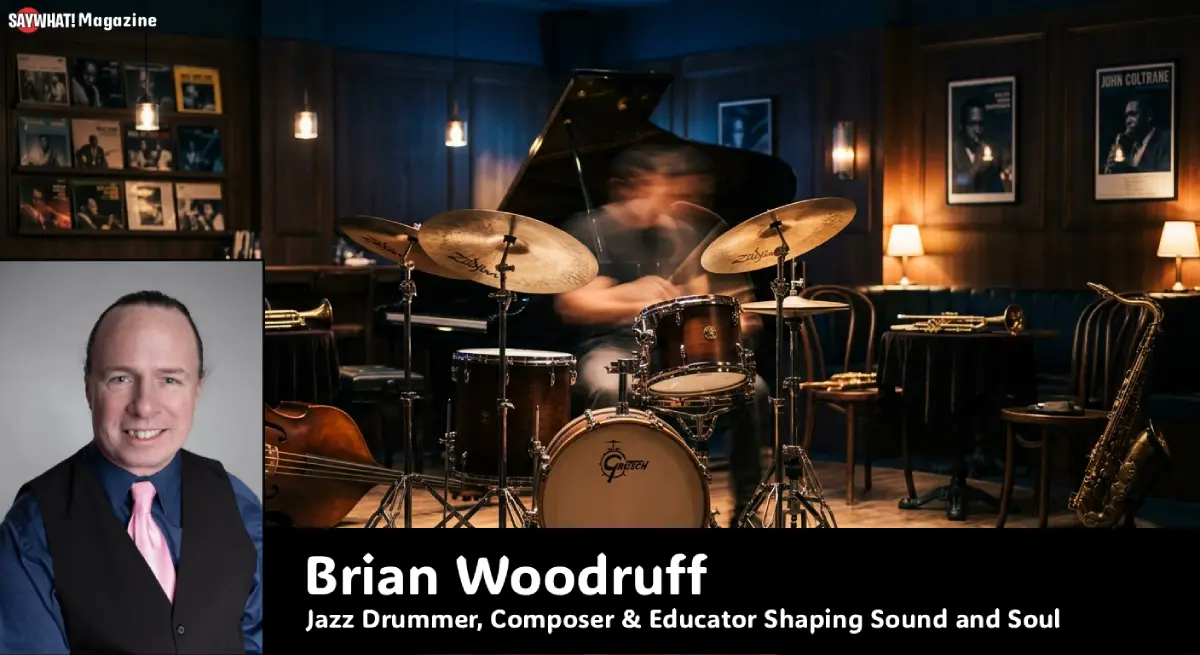
Brian Woodruff is an Astoria, NY–based jazz drummer, composer, and percussion educator known for his disciplined yet joyful approach to drumming and music education. As the Percussion Department Chair at the Brooklyn Music School and house drummer for Unity of New York, he has led ensembles such as the Blackbird’s Session and recorded acclaimed albums like “The Ing” and “A Centering Peace”, which showcase his original compositions and collaborations with top‑tier jazz artists, blending tradition, groove, and contemporary sound.
Who Is Brian Woodruff?
Brian Woodruff is an Astoria, New York–based jazz drummer, composer, and percussion educator whose work bridges performance, recording, and teaching. He is best known as the house drummer for Unity of New York, Percussion Department Chair at the Brooklyn Music School, and leader of his own jazz recordings such as “The Tarrier,” “The Ing,” and “A Centering Peace,” which have earned critical praise and chart recognition in the jazz world.
From Connecticut to New York: Early Life and Musical Roots
Woodruff started private drum lessons around age twelve. His early listening was rooted in classic rock, but his ear gradually shifted toward jazz. By nineteen, while studying for a bachelor’s degree in classical percussion at the University of Connecticut, he entered what he calls his “jazz snob phase” — though he’d outgrow it during his master’s program in jazz and commercial music.
Those formative years built a broad musical vocabulary. He was absorbing jazz, rock, Latin, and classical percussion simultaneously, which later became a defining feature of his playing style. Few drummers can swing hard and then pivot to a Brazilian groove without losing the thread of the music. Woodruff makes that transition feel natural.
Formal Training and Key Mentors
Woodruff holds a Bachelor of Music in Applied Percussion from the University of Connecticut and a Master’s Degree in Jazz and Commercial Music from the Manhattan School of Music. During his time in school, he had the opportunity to study with John Riley, Justin DiCioccio, and Bill Stewart, among others.
These three names carry serious weight in jazz percussion. John Riley is one of the most respected jazz drum educators in the world. Justin DiCioccio ran the jazz program at Manhattan School of Music for decades. Bill Stewart is a consummate modern jazz drummer known for his work with Pat Metheny and John Scofield. Studying under all three gave Woodruff a complete technical and musical foundation.
The New York Performance Career
After finishing graduate school, Woodruff went deep into New York’s working musician life. He played in the subway, did national tours with Broadway musicals, and covered jazz composition workshops, standards gigs, club dates, chanson, cabaret, and reggae bands. That range of experience is exactly why he can teach across styles today.
He has performed with Bobby Watson, Marian McPartland, Rufus Reid, Gary Versace, James Spaulding, Jimmy Heath, Harvie S, Sherman Irby, Robin Eubanks, Ledisi, Melba Moore, and appeared on the Today Show. These aren’t casual name-drops. Watson, McPartland, Heath, and Reid are jazz legends. Performing alongside them at that level requires genuine musicianship.
Woodruff also served as the house drummer for Unity of New York, a new-thought church that held Sunday gatherings at Symphony Space since 2002. Weekly church gigs build consistency and stamina in ways that sporadic concert dates simply don’t.
The Blackbird’s Session and Bandleading
One of Woodruff’s most significant contributions to New York’s jazz community was organizing and leading the Blackbird’s Session. As its founder, he played with a revolving cast of New York’s finest jazz players during its 3.5-year run.
Running a regular jazz session is harder than it sounds. You’re recruiting musicians, managing logistics, building an audience from scratch, and holding the rhythm section down night after night. That Woodruff kept it going for three and a half years says a lot about both his organizational ability and his reputation among New York jazz players.
He is also a founding member of the Queens Jazz OverGround and currently serves as its Executive Director. The Queens Jazz OverGround promotes live jazz in the borough through performances, educational programming, and community outreach — a mission that fits naturally with Woodruff’s dual identity as performer and educator.
Discography: Key Albums as a Leader
The Tarrier
“The Tarrier,” his first CD as a leader, has garnered rave reviews and critical acclaim. It features his sextet, including Lisa Parrott on saxophones, Jacob Varmus on trumpet and cornet, Alan Ferber on trombone, Nate Radley on guitar, and Matt Closehy on bass — all Woodruff originals covering a wide range of moods, grooves, and harmonic styles.
The Ing (OKB Trio)
In April 2018, the OKB Trio, featuring Oscar Perez on piano and Kuriko Tsugawa on bass alongside Woodruff on drums, released their studio CD “The Ing.” Trio recordings reveal a drummer most clearly. With no horn players to fill space, every choice the drummer makes is exposed. Reviews praised the interplay between all three musicians and the group’s ability to communicate at a high level without overplaying.
A Centering Peace
His third album as a leader carries a more spiritual theme. Reviews from All About Jazz describe it as a dedicated album with a concept tied to Woodruff’s spiritual advisor, Monsignor Edward Straub. The title track was written to celebrate a significant milestone in his life. The album features his long-standing sextet and moves through several musical directions, from meditative to up-tempo.
Album Comparison at a Glance
| Album | Format | Year | Key Collaborators | Style |
|---|---|---|---|---|
| The Tarrier | Sextet | Early 2000s | Lisa Parrott, Jacob Varmus, Nate Radley | Post-bop, originals-focused |
| The Ing | Trio | 2018 | Oscar Perez, Kuriko Tsugawa | Contemporary jazz trio |
| A Centering Peace | Sextet | Later release | Long-standing sextet members | Spiritual jazz, thematic |
Teaching at Brooklyn Music School
Woodruff serves as Chair of the Percussion Department at Brooklyn Music School. In that role, he oversees a full faculty of drum and percussion instructors across multiple styles and formats.
His teaching philosophy centers on a serious and disciplined approach to fundamentals: reading, stick height, rudiments, dynamics, coordination, and drum set styles covering rock, jazz, and Latin — all delivered with fun and positivity. That last part matters. Students who feel pressured and bored quit. Students who feel challenged and engaged keep playing.
He teaches students from age four through adult, beginner through advanced. That range demands real flexibility. Explaining syncopation to a seven-year-old requires a completely different vocabulary than discussing polyrhythmic independence with an adult intermediate student.
The drum department at BMS has hosted notable masterclasses, including a visit from Living Colour drummer Will Calhoun, demonstrating the school’s commitment to connecting students with professional artists. These kinds of events bridge the gap between classroom instruction and the real-world music industry.
What Makes His Teaching Approach Work
Woodruff’s method isn’t built around one style or one technique. It’s built around fundamentals that transfer across every genre. Here’s what defines his approach:
- Reading music: Drummers who can’t read notation are limited in professional settings. Woodruff prioritizes this from early lessons.
- Rudiments: The building blocks of all stick technique. Mastering them opens up improvisation options that feel intuitive rather than forced.
- Dynamics: Knowing when to play quietly is as important as knowing when to drive hard. This separates good drummers from great ones.
- Coordination: Independence between hands and feet is what allows a drummer to hold down a groove while responding to the rest of the band.
- Style fluency: Rock, jazz, and Latin are treated as distinct languages, each with its own vocabulary and feel.
The Performer-Educator Balance
One of the harder things to maintain in a music career is staying active as a performer while building a serious teaching practice. Many musicians drift entirely into one or the other. Woodruff has kept both going for decades.
Recent live performance work includes collaborations with Brenda Earle Stokes, Vicki Burns, the Takaaki Otomo Trio, the Lee Tomboulian Trio, Lauren Lee, Takeshi Asai, Elizabeth Tomboulian, the New-Trad Octet, Andrea Balducci, Church of the Village, and Marieann Meringolo.
That active roster tells you the playing hasn’t taken a back seat to teaching. It also means his students are learning from someone who is actively navigating the same challenges they’ll face once they leave the classroom.
Composition as a Core Identity
Woodruff doesn’t just play other people’s music. He wrote all of the music for his sextet, aiming to cover a wide variety of moods, grooves, and harmonic styles — with a focus on giving audiences hummable melodies and a deep groove.
That balance between accessibility and sophistication is difficult to achieve. A lot of jazz composition leans too far in one direction. Woodruff’s stated goal of writing music people can actually hum while also satisfying jazz musicians is a practical and artistic target worth chasing.
He has continued developing new material. His recent compositions include Astral Flower, described as an up-tempo “Americanized” bossa nova set in F# minor, premiered during a 2023 concert in Brooklyn.
Legacy and Ongoing Work
What Woodruff has built over thirty-plus years isn’t a single achievement — it’s a career made of consistent decisions to show up, practice, collaborate, teach, and record. His influence runs through every student who has come through Brooklyn Music School’s percussion program, every musician who played the Blackbird’s Session, and every community member who has attended a Queens Jazz OverGround event.
He represents something increasingly rare: a working jazz musician who is also a serious educator and a genuine community builder. None of those roles came at the expense of the others.
For anyone learning drums in New York, studying jazz performance, or looking for a model of how to sustain a music career over the long term, Brian Woodruff’s path is worth paying attention to.
Key Takeaways for Aspiring Drummers
If there’s a practical lesson in Woodruff’s career, it’s this: fundamentals are not boring. They are the reason experienced musicians keep calling you back.
- Start with reading, rudiments, and dynamics before worrying about style.
- Learn multiple genres. Rock, jazz, and Latin aren’t separate careers — they’re tools in the same kit.
- Get into the community. The Blackbird’s Session didn’t happen by accident. It was built through relationships and initiative.
- Teach what you know. Explaining music to someone else forces you to understand it more clearly yourself.
- Keep performing. A musician who only teaches eventually stops having new things to say.
Woodruff has followed his own advice consistently, and that consistency is exactly what a long career in jazz demands.
