
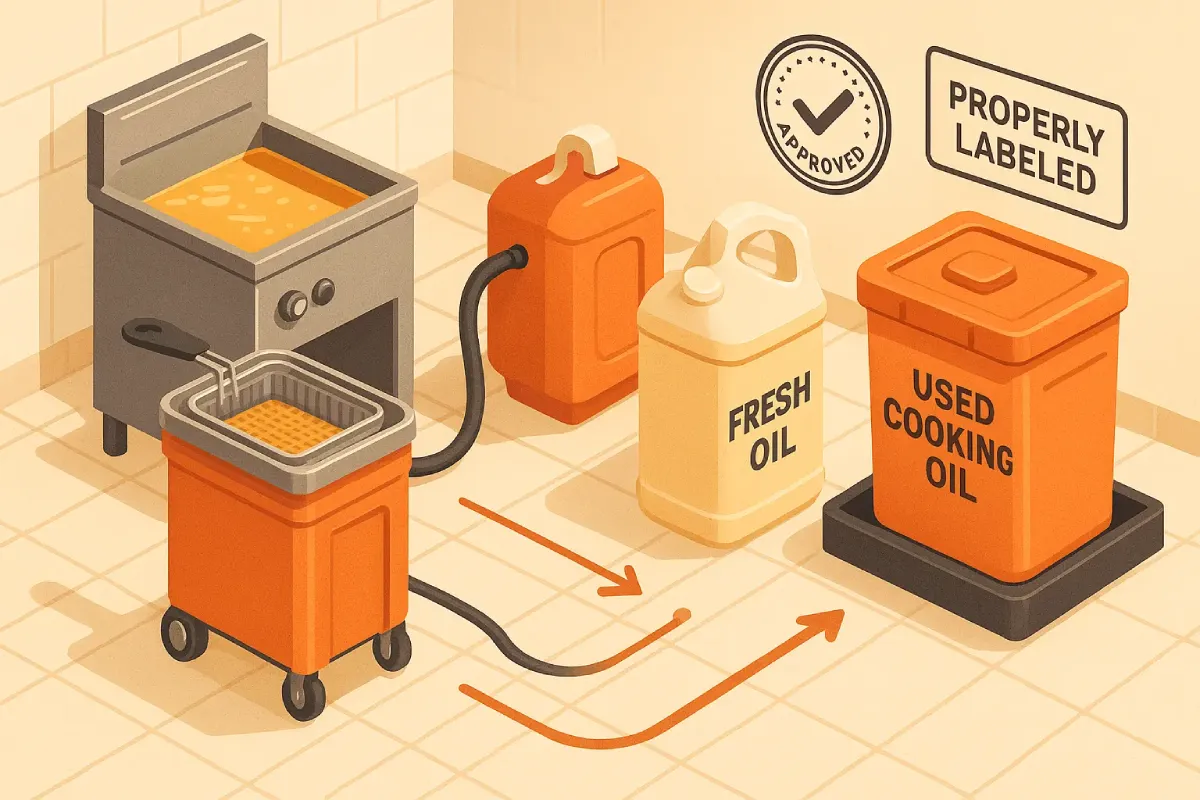
Used fryer oil is not ordinary kitchen rubbish. Once oil has been heated repeatedly, it contains food particles, moisture, odours and by-products that make it messy, slippery and environmentally harmful if handled badly. Poor fryer oil disposal can block drains, attract pests, pollute watercourses, create fire risks and expose a food business to enforcement action. Safe disposal is straightforward when the oil is cooled, contained, documented and collected by an authorised waste operator.
The first rule is simple: never pour used cooking oil into sinks, toilets, yard drains or grease traps as a disposal method. Even warm oil that looks liquid will cool, thicken and bind with food residues inside pipework. Over time it contributes to fatbergs, bad smells, vermin problems and expensive drainage call-outs. A grease trap is designed to intercept fats, oils and grease from wash water; it is not a tank for dumping fryer contents.
Safe handling starts at the fryer. Turn the appliance off, allow the oil to cool to a manageable temperature, and drain it only through the equipment’s intended valve or filtration system. Staff should wear heat-resistant gloves, an apron and slip-resistant footwear. Do not carry open pans of hot oil through a kitchen. Transfer the cooled oil into a clean, sealable, clearly labelled container supplied or approved by your collector. Keep water, detergents, chemicals, engine oil and other wastes out of the container, because contamination can turn a recyclable resource into a costly disposal problem.
Storage matters as much as collection. Waste cooking oil should be kept in a secure area away from food preparation surfaces, ignition sources, pests and public access. Containers should be strong, lidded, upright and easy to clean around. Any spill should be treated immediately with absorbent material and recorded if your food safety or environmental procedure requires it. A simple checklist for closing shifts can prevent most problems: fryer filtered, waste oil container closed, floor cleaned, no leaks, collection level checked.
For commercial kitchens, legality depends on using the right route. Waste oil from catering premises should be collected by an authorised collector and taken to an authorised site for recovery or disposal. It should not be put into general waste, mixed with food waste, tipped into bins, taken to household recycling centres, or placed in engine oil banks. Household facilities are not for commercial waste, and cooking oil can contaminate oil-bank recycling streams.
Documentation is the part many businesses underestimate. Keep evidence that your oil left the premises through a lawful route. Depending on your jurisdiction and waste classification, this may include waste transfer notes, collection receipts, consignment notes, contracts, invoices, collector permit details, destination facility details and quantities collected. Store these records in one place and make sure managers can produce them during an inspection. A low-cost collection service is not a bargain if it cannot provide a clear audit trail.
In the Republic of Ireland, businesses searching for waste oil collection ireland should check that the collector holds the appropriate waste collection permit and that the destination facility is authorised. A proper collector should confirm the waste type accepted, collection area, container size, schedule, emergency spill procedure and paperwork provided after each collection. If a provider is vague about permits, subcontracting or where the oil goes, treat that as a compliance risk rather than a convenience.
The same principle applies in Northern Ireland. When comparing Waste Oil Collection Northern Ireland providers, do not choose on price alone. Ask whether the operator is authorised to transport the waste, whether the receiving site is licensed or otherwise authorised, and what documents you will receive. Enforcement for cooking oil waste can involve both district council environmental health teams and the Northern Ireland Environment Agency, so food hygiene and environmental compliance should be treated as one joined-up process.
Used fryer oil also has a circular-economy value. When collected properly, it can often be recovered and processed into products such as biodiesel or other industrial feedstocks. That is why separation is important. Cleaner oil, free from water and chemical contamination, is easier to recover and may reduce collection costs. Some collectors provide sealed drums, intermediate bulk containers or automated tank systems for high-volume kitchens. Larger sites should consider collection frequency, tank capacity, bunding, staff access and vehicle access before choosing a system.
There are several disposal mistakes to avoid. Do not give used cooking oil to farmers, pet owners or anyone who wants to use it in animal feed. Do not leave containers unsecured outside, where they can be stolen, spilled or filled with rainwater. Do not mix fryer oil with waste lubricating oil, fuel, solvents or cleaning chemicals. Do not assume a one-off event, food truck or temporary kitchen is exempt from waste obligations. If food is being prepared commercially, the waste stream still needs a lawful route.
A good fryer oil disposal procedure should be written, trained and monitored. It can be short, but it should state who drains the fryer, when oil is changed, what personal protective equipment is required, which container is used, where it is stored, who books collections, what to do after a spill and where records are filed. New staff should be shown the process before they are asked to clean fryers. Supervisors should check containers weekly and review collection paperwork monthly.
Households have a different scale of responsibility, but the same environmental logic applies. Small amounts of cooled cooking oil can often be wiped from pans with kitchen paper and placed in the appropriate residual waste, or stored in a sealed container for local recycling where available. Householders should follow local council guidance and should never pour oil down drains or onto the ground. The key difference is that commercial kitchens must not rely on domestic civic amenity routes for business waste.
Safest is to treat used fryer oil as a controlled operational waste stream, not an afterthought. Choose an authorised collector, keep oil separate and sealed, prevent spills, maintain records, and review your process whenever your menu, frying volume or site layout changes. Done correctly, fryer oil disposal protects drains, staff, customers, wildlife and your licence to operate. It also turns a messy by-product into a recoverable resource, which is the best outcome for both compliance and sustainability.
