
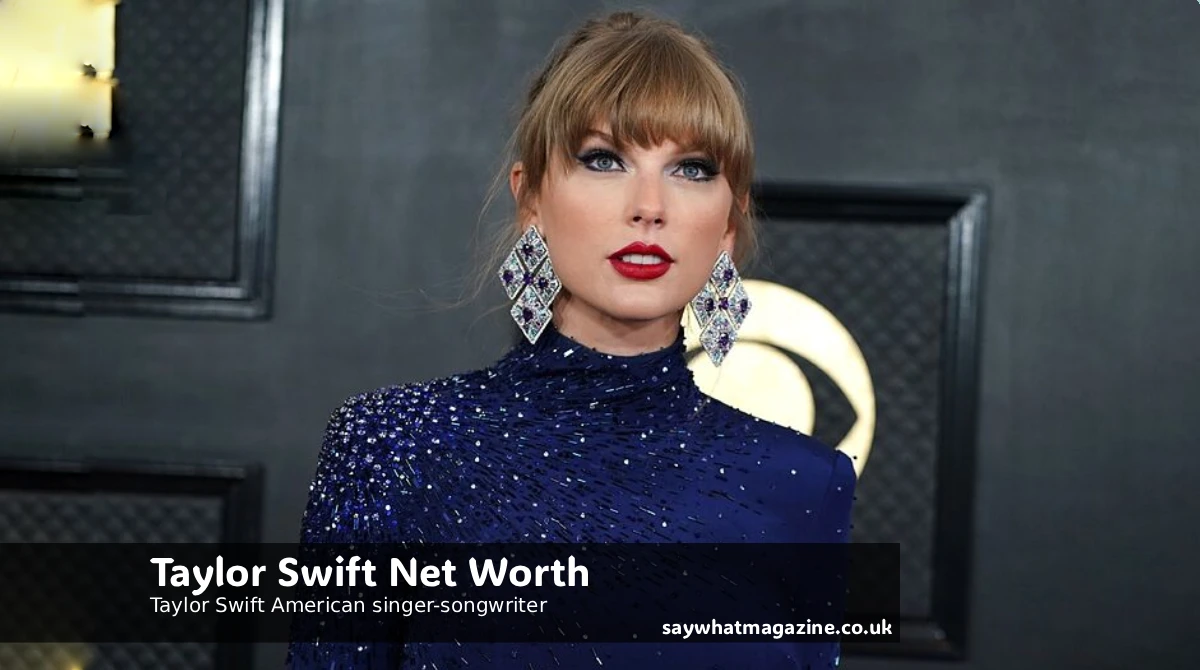
She started with a guitar and a dream in a small Pennsylvania town. Today, Taylor Swift sits at the top of the financial world with a verified net worth of $1.8 billion — making her the first musician in history to reach billionaire status through music and performances alone, with no inheritance, no tech startup, and no Hollywood franchise to thank. This is the story of how one artist turned raw talent into a multi-billion dollar empire, and exactly where every dollar comes from.
Taylor Swift Net Worth $1.8 Billion: The Latest Figures
According to Forbes’ April 2026 update, Taylor Swift’s net worth stands at approximately $1.8 billion. Bloomberg independently corroborated the figure, factoring in her music catalog, real estate holdings, ongoing streaming revenue, and Eras Tour residuals still flowing into her accounts well after the tour’s conclusion.
What makes this number remarkable is its trajectory. Swift was worth an estimated $400 million in 2019. By 2023, she crossed the billionaire threshold. By 2026, she has nearly doubled that figure — a rate of wealth accumulation that rivals Silicon Valley executives, not pop stars.
How Net Worth Is Calculated for Celebrities
Forbes uses a straightforward but rigorous methodology: total assets minus total liabilities. For Swift, that means adding up verified earnings from tours, streaming, catalog ownership, real estate, and brand deals — then subtracting taxes, legal costs, and operational expenses. This isn’t a guess. It’s built on tour grosses confirmed by concert promoters, streaming data from Spotify and Apple, and property records from public filings.
How Taylor Swift Built Her $1.8 Billion Empire
Swift’s wealth doesn’t come from one source. It’s a carefully diversified portfolio of income streams that compound on each other. Here’s roughly how it breaks down:
- ~50% Touring revenue
- ~30% Music royalties and catalog value
- ~12% Endorsements and brand deals
- ~8% Real estate and other investments
Touring Revenue: Eras Tour’s Record $2 Billion Gross
The Eras Tour is the single most important financial event in Swift’s career — and arguably in live music history. The tour grossed over $2 billion globally, shattering every previous record including Elton John’s Farewell Yellow Brick Road tour. It sold out stadiums across six continents, with resale ticket prices averaging three to four times face value.
Beyond ticket sales, merchandise at each venue generated an estimated $200–$300 per attendee in additional revenue. Multiply that across millions of attendees, and the numbers become staggering. Critically, Swift owns her touring operation through her production company, which means far less revenue is lost to promoter splits compared to typical artist deals.
Music Sales and Streaming Royalties
Swift’s streaming numbers are consistently among the highest in the world. She regularly tops Spotify’s annual charts, translating into tens of millions of dollars in royalty payments each year.
But the deeper story is her re-recording strategy. After talent manager Scooter Braun’s company acquired her original masters in 2019, Swift embarked on one of the most audacious moves in music business history — re-recording her first six albums as “Taylor’s Versions.” The strategy served two purposes: it reclaimed her artistic and commercial control, and it dramatically increased the value of her new catalog. Brands, films, and streaming platforms that want to use her music now largely license the Taylor’s Versions, which she owns outright.
The estimated value of her owned catalog: upwards of $400 million.
Endorsements and Brand Deals
Swift has been selective with brand partnerships, which has kept her endorsement power unusually high. Past deals with Diet Coke, Apple Music, and AT&T have been replaced by a shorter, more lucrative list of premium partnerships. Each major deal is reported to generate $20–$50 million, and her ability to drive measurable consumer behavior — what analysts have called the “Swift Effect” — makes her one of the most bankable endorsers on the planet.
Her partnership visibility during the NFL season in 2023 and 2024, stemming from her relationship with Travis Kelce, introduced her to an entirely new demographic of consumers and added commercial value that brands were quick to capitalize on.
Career Milestones That Skyrocketed Her Wealth
Swift’s financial rise mirrors her artistic one. Every major career pivot brought a corresponding leap in income.
| Year | Milestone | Estimated Net Worth |
|---|---|---|
| 2006 | Debut album release | ~$2M |
| 2010 | Fearless Grammy sweep | ~$45M |
| 2014 | 1989 pop crossover | ~$200M |
| 2019 | Masters dispute; re-recording announced | ~$400M |
| 2023 | Eras Tour launch; billionaire milestone | ~$1.1B |
| 2026 | Post-tour residuals + catalog growth | ~$1.8B |
The Re-Recording Strategy: A Masterclass in Ownership
The Taylor’s Versions project deserves its own business school case study. By re-recording her catalog, Swift effectively created a parallel, fan-supported alternative to her original masters. Streaming platforms saw listeners migrate almost entirely to the new versions within weeks of each release. What started as a fight for artistic justice became one of the most strategically brilliant ownership moves in entertainment history — and added hundreds of millions to her bottom line.
Investments and Assets Fueling $1.8 Billion
Music and touring are the engine, but Swift’s real estate and investment portfolio provide crucial stability.
Real Estate Empire
Swift’s property portfolio is estimated at $150 million or more, spanning several of America’s most expensive real estate markets:
- New York City – A Tribeca townhouse purchased for $18 million, plus adjacent units she acquired to create a private compound
- Nashville – Her original Tennessee home, now a landmark, plus additional properties
- Beverly Hills / Rhode Island – Multiple estates used as primary residences and retreats
Real estate has been both a lifestyle choice and a savvy hedge against inflation — her NYC properties alone have appreciated significantly since purchase.
Other Assets
Swift owns a private jet fleet — a point of public controversy regarding carbon emissions, but also a reflection of the logistical reality of touring at her scale. She has also been linked to quiet stakes in early-stage ventures, though these remain largely unverified.
Her two Scottish Fold cats, Meredith Grey and Olivia Benson (and newer addition Benjamin Button), have their own cultural value — each Instagram appearance generates measurable media coverage and brand visibility worth millions in equivalent advertising spend.
Taylor Swift Net Worth Compared to Peers
How does $1.8 billion stack up in the world of celebrity wealth?
| Artist | Estimated Net Worth | Primary Wealth Source |
|---|---|---|
| Jay-Z | ~$2.5B | Music, Armand de Brignac, art |
| Taylor Swift | ~$1.8B | Music, touring, catalog |
| Rihanna | ~$1.4B | Fenty Beauty, music |
| Paul McCartney | ~$1.3B | Beatles catalog, touring |
| Beyoncé | ~$800M | Music, Ivy Park, touring |
What distinguishes Swift from almost everyone on this list is that her wealth is music-first. Rihanna’s billionaire status is largely driven by Fenty Beauty, not her albums. Jay-Z’s wealth is significantly tied to spirits and art investments. Swift built her $1.8 billion primarily through the craft itself — a genuinely rare achievement.
Philanthropy and Expenses Impacting Net Worth
Wealth at this scale comes with significant outflows, both voluntary and mandatory.
Swift has donated over $100 million to various causes, including food banks, disaster relief, education funds, and direct payments to fans in financial hardship. During the Eras Tour, she reportedly gave $55 million in bonuses to touring crew members — an extraordinary act that generated massive goodwill and press coverage.
On the expense side, federal and state taxes consume roughly 37–50% of ordinary income. Legal costs related to the ongoing master recordings dispute and various other IP matters have also run into the tens of millions. The net effect: her actual take-home on a $2 billion tour is substantial, but significantly less than the headline gross.
Future Projections for Taylor Swift’s Net Worth
Conservative analysts project Swift’s net worth crossing $2.5 billion by 2030, assuming continued streaming growth, a potential Reputation-era stadium tour, and appreciation in her owned catalog value. A future catalog sale — should she ever choose to monetize it directly — could generate a single transaction worth $500 million or more.
The streaming economy continues to mature in ways that benefit catalog owners. As AI-generated music floods platforms, human-created legacy catalogs from proven artists are expected to command premium licensing rates. Swift, who now owns her post-2019 work outright, is exceptionally well-positioned.
Frequently Asked Questions
What is Taylor Swift’s net worth in 2026?
Taylor Swift’s net worth is approximately $1.8 billion as of April 2026, according to verified estimates from Forbes and Bloomberg.
How did Taylor Swift become a billionaire?
Through a combination of record-breaking touring (primarily the Eras Tour), owned music catalog royalties, selective brand endorsements, and real estate investments — with no inheritance involved.
Who owns Taylor Swift’s masters now?
Her original six albums’ masters are owned by Shamrock Holdings (which acquired them from Scooter Braun’s company). Her re-recorded Taylor’s Versions, along with all music from Folklore onward, are owned by Swift herself.
How much did the Eras Tour make?
The Eras Tour grossed over $2 billion globally, making it the highest-grossing concert tour in history.
Is Taylor Swift richer than Rihanna?
Yes. Swift’s estimated net worth of $1.8 billion currently exceeds Rihanna’s estimated $1.4 billion, though Rihanna’s Fenty Beauty continues to grow rapidly.
Conclusion
Taylor Swift’s $1.8 billion net worth is more than a celebrity headline — it’s a blueprint. She combined artistic excellence with strategic ownership, diversified across tours, royalties, real estate, and endorsements, and turned a dispute over her masters into one of the most profitable pivots in music business history. For artists, entrepreneurs, and fans alike, the lesson is clear: talent opens the door, but ownership builds the empire. As streaming matures and her catalog compounds in value, the $1.8 billion figure looks less like a ceiling and more like a checkpoint on a longer journey.
