
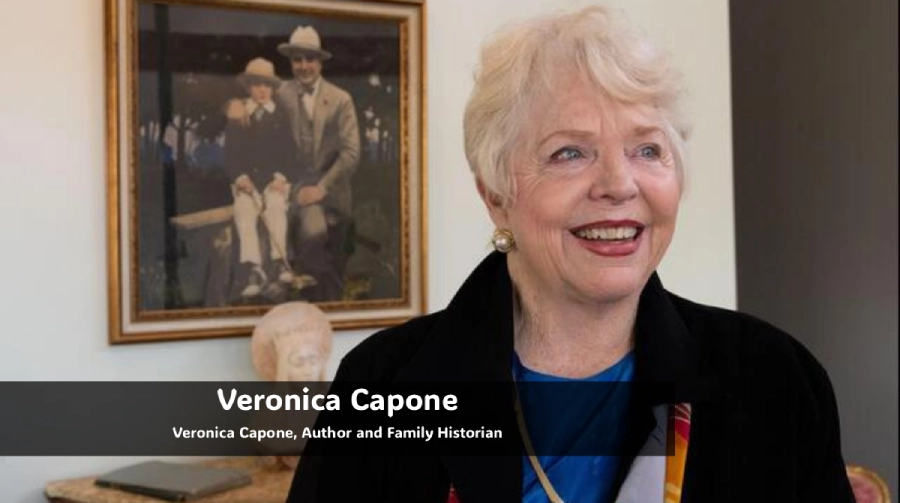
When most people hear the name Veronica Capone, their minds immediately jump to Tommy guns, Prohibition-era Chicago, and one of America’s most feared crime bosses. But there’s another side to the Capone story — one that rarely makes headlines. It’s the story of a woman who inherited a notorious surname and quietly chose to do something remarkable with it: nothing. No crime, no drama, no tabloid scandals.
Veronica Frances “Ronnie” Capone Peterson was born on January 9, 1943, in Miami Beach, Florida — the eldest granddaughter of Al Capone himself. She lived 64 years largely out of the public eye, building a life defined by compassion, love of travel, and genuine warmth toward others. She passed away on November 17, 2007, from Acute Myelogenous Leukemia. Her story is one of quiet resilience and personal reinvention — and it deserves to be told properly.
Early Life and Birth
Veronica came into the world at a complicated moment for her family. By 1943, the Capone era in Chicago was well and truly over. Her grandfather, Al Capone, had served his federal prison sentence and was living out his final years in declining health at the family’s Palm Island estate in Miami Beach. The empire had crumbled. What remained was a family trying to move forward.
Her father, Albert Francis “Sonny” Capone, was Al Capone’s only son. Sonny had grown up under enormous pressure — a hearing loss from childhood meningitis, the constant glare of media scrutiny, and the impossible task of being the son of Public Enemy Number One. By the time Veronica was born, Sonny was working as an accountant in Florida and actively distancing himself from the Capone legacy.
Veronica grew up in Miami Beach, raised Catholic like her parents, attending school without fanfare. She would have been barely four years old when her grandfather Al died in January 1947. Most of what she knew of him came secondhand — from her father and grandmother, not from newspapers or crime documentaries. To her, he was simply “Papa.”
Veronica Capone Family Tree and Key Relationships
Understanding Veronica’s life means understanding who surrounded her. Her family tree is a mix of infamy and quiet dignity — a contrast that defined the world she grew up in.
| Relation | Name | Years | Key Facts |
|---|---|---|---|
| Grandfather | Al Capone | 1899–1947 | Prohibition-era gangster; died of cardiac arrest |
| Grandmother | Mae Coughlin Capone | 1897–1986 | Devoted Catholic wife; managed family finances |
| Father | Albert “Sonny” Capone | 1918–2004 | Al’s only son; later changed name to “Brown” |
| Mother | Diana Ruth Casey | 1922–2004? | Met Sonny at St. Pat’s Catholic School in Miami Beach |
| Sisters | Patricia (Diane), Barbara, Teresa | 1940s– | Lived private lives; Diane became a public author |
| Husband | Gordon Peterson | Unknown–? | Married 31+ years; couple retired to Auburn, California |
Sonny Capone’s decision to eventually change his surname to “Brown” says everything about the family’s relationship with the Capone name. It wasn’t something they wore with pride — it was a weight they worked to put down. He raised his daughters to move through the world with dignity, teaching them that people who made snide remarks about their last name were simply ignorant, not worth getting upset over.
That kind of grounded parenting shaped all four sisters. Veronica, being the eldest, likely absorbed those lessons most directly.
Childhood and Youth
Growing up in Miami Beach in the 1940s and 1950s, Veronica’s childhood was, by most accounts, genuinely normal. The family lived near the Palm Island estate where her grandfather had spent his final years — a reminder of the past that was never far away, but also never all-consuming.
She attended Catholic school, had sisters to grow up alongside, and developed the curious, adventurous personality that would later define her adult life. There’s no record of her being drawn toward anything criminal or even particularly rebellious. She was, by all indications, a fairly ordinary girl who happened to share DNA with one of history’s most notorious criminals.
As a teenager, she would have navigated the inevitable questions and awkward moments that came with the Capone name. But her father had prepared her well. Rather than feeling ashamed or defensive, Veronica seemed to develop a kind of philosophical acceptance — an ability to separate her identity from her grandfather’s actions.
This emotional intelligence, developed early, would become one of her defining traits.
Marriage and Adulthood
Veronica married Gordon Peterson in 1976. By all accounts, it was a genuinely happy marriage that lasted over 31 years — right up until her death in 2007. Those who knew the couple described Gordon as “the love of her life,” and the relationship seemed to be built on genuine partnership and shared adventure.
The couple eventually relocated to Auburn, California around 1990, where they settled into a quieter chapter of life. Veronica embraced her role as stepmother to Gordon’s five children: Rod Bacon, LeeRae Bacon Walter, DeVon Bacon Harbolt, Eric Peterson, and Cassie Peterson. She didn’t have biological children, but by all accounts she poured real love and energy into those stepfamily relationships.
Life in Auburn suited her. She wasn’t chasing celebrity or trying to trade on her family name. She was just living — traveling, reading, cooking, and engaging with the world around her on her own terms.
Passions and Personality
One of the most striking things about Veronica Capone is how full her life actually was. People who knew her painted a picture of someone who genuinely embraced everything life had to offer.
Her passions included:
- Travel — She explored many parts of the world, with Africa standing out as a particular favorite. She visited the continent multiple times and was moved deeply by its landscapes and people.
- Food — Friends described her culinary knowledge as surpassing “any four-star chef.” She wasn’t just someone who enjoyed eating well; she understood food on a deeper level.
- Arts and culture — Ballet, film, music, and literature all held genuine meaning for her. She wasn’t just dabbling; she engaged seriously with creative work.
- Political debate — She loved a good argument. Friends noted she could disagree fiercely with someone while still making them feel respected. Most of her debates reportedly ended in laughter rather than resentment — a rare and admirable quality.
- Volunteer work — Perhaps most tellingly, she regularly drove disabled veterans to medical appointments, sometimes covering hundreds of miles to do so. She also supported a village school in Samburu, Kenya, reflecting an international sense of responsibility.
This is not the portrait of someone coasting on a famous surname. It’s the portrait of a person actively choosing how to spend her time and energy.
Timeline of Veronica Capone’s Life
- January 9, 1943 — Born in Miami Beach, Florida, to Sonny and Diana Capone
- 1947 — Grandfather Al Capone dies; Veronica is four years old
- Late 1940s–50s — Catholic school upbringing in Miami Beach; three younger sisters born
- 1976 — Marries Gordon Peterson
- 1990 — Couple relocates and retires to Auburn, California
- June 2007 — Diagnosed with Acute Myelogenous Leukemia (AML)
- 2007 — Undergoes chemotherapy at Mercy San Juan Hospital; enters clinical trial at Stanford Hospital
- November 17, 2007 — Passes away at Auburn Faith Hospital, aged 64
Health Struggles and Death
In June 2007, Veronica was diagnosed with Acute Myelogenous Leukemia — an aggressive form of blood cancer that moves quickly. She was 64 years old.
She didn’t retreat from the fight. She underwent nearly three months of chemotherapy at Mercy San Juan Hospital, then enrolled in a clinical trial at Stanford Hospital. Her decision to join the trial was, in itself, revealing of her character. She reportedly said that even if the treatment didn’t save her, the data gathered might help someone else down the line. That kind of selflessness in the face of a terminal diagnosis isn’t common.
When the clinical trial proved unsuccessful, she returned home and was admitted to Auburn Faith Hospital. She died there on November 17, 2007, surrounded by family. She was buried in Auburn, California.
Myths vs. Facts
There’s a lot of confusion surrounding Veronica Capone online — partly because the Capone name attracts so much speculation, and partly because she was so deliberately private.
| Common Myth | The Reality |
|---|---|
| She was involved in organized crime | She lived entirely privately, with no known criminal connections |
| She’s still alive | Veronica died on November 17, 2007, from leukemia complications |
| She was a public figure | She actively avoided the spotlight her whole adult life |
| She and her sister Diane are the same person | They are two separate people; Diane became a public author, Veronica did not |
| The Capone grandchildren lived in luxury off crime money | The family lived middle-class lives in Florida and California |
The confusion between Veronica and her sister Diane (Patricia) is worth addressing specifically. Diane gave interviews about the family and wrote books correcting popular myths about Al Capone. Veronica did neither. They were distinct people with different relationships to the family legacy — and conflating them does both women a disservice.
Legacy and Impact on the Capone Narrative
What Veronica Capone ultimately represents is something the broader Capone story rarely gets to explore: the human cost of notoriety across generations. Al Capone’s crimes weren’t just his own. They were inherited — not in a legal sense, but in a social and psychological one — by every child, grandchild, and relative who came after him.
Veronica’s response to that inheritance was to quietly refuse it. She didn’t sensationalize her family history, didn’t write a memoir, didn’t give tell-all interviews. She just lived. And in doing so, she shifted what it meant to be a Capone — even if most people never knew her name.
Her sister Diane’s more public advocacy for reexamining Al Capone’s legacy has drawn media attention. But Veronica’s quieter path arguably speaks just as loudly. You don’t need a book deal to reclaim your identity. Sometimes you just need a long marriage, a few trips to Africa, and a willingness to drive veterans to their appointments on a Tuesday morning.
Conclusion
Veronica Frances “Ronnie” Capone Peterson was born into one of America’s most infamous family names and chose, every single day, to make it mean something different. She didn’t rage against the Capone legacy or exploit it. She simply built her own life — full of travel, love, debate, good food, and genuine service to others.
She died in 2007 at 64, having lived quietly and well. That, in its own way, is the most remarkable thing about her story.
